
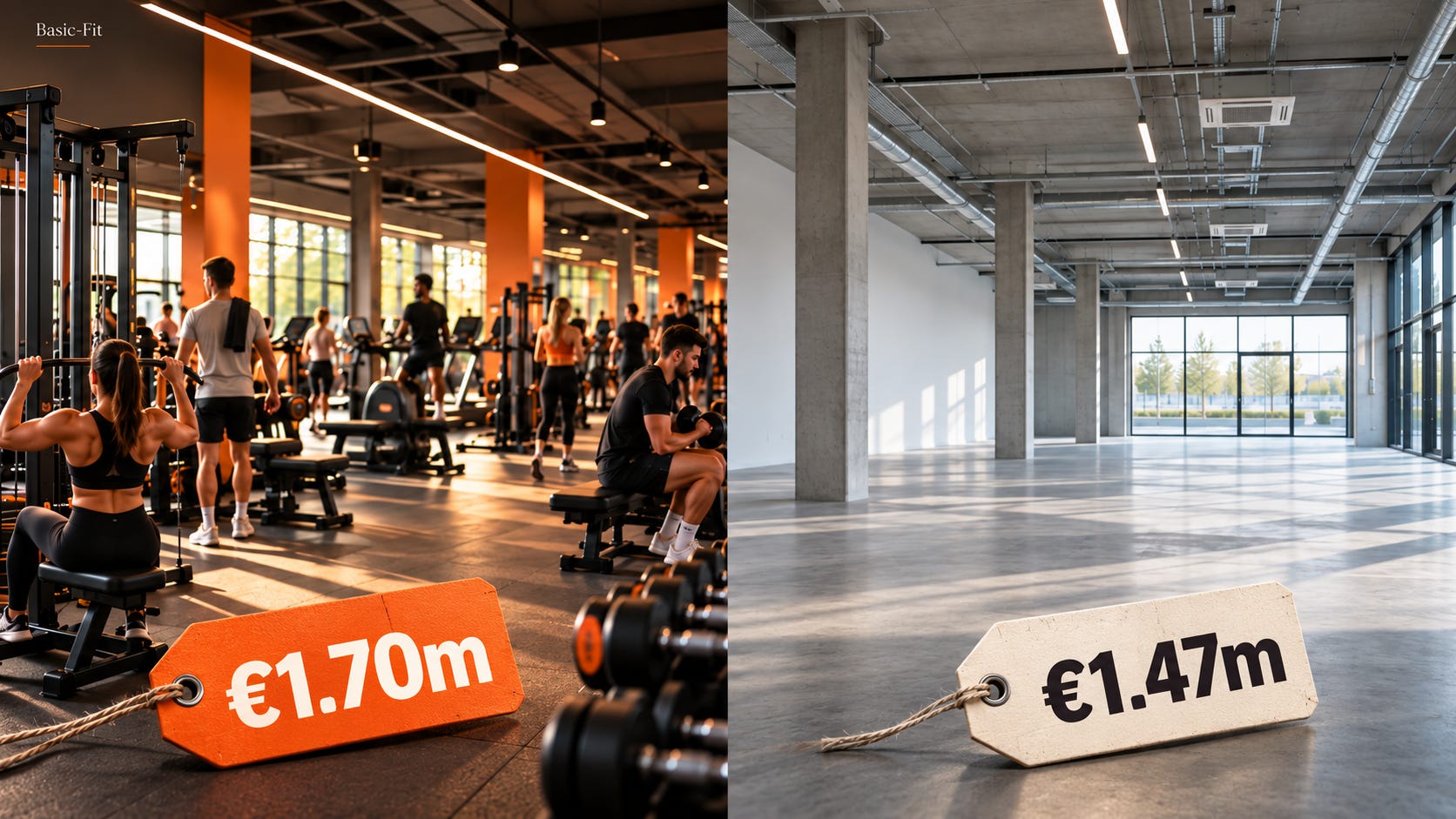
In July, Basic-Fit (ticker: BFIT) told us what an empty gym costs. The 39 clubs it built in the first half of 2026 came in at €1.47 million each, against €1.38 million a year earlier. Bigger boxes, a new design, and plain construction inflation.
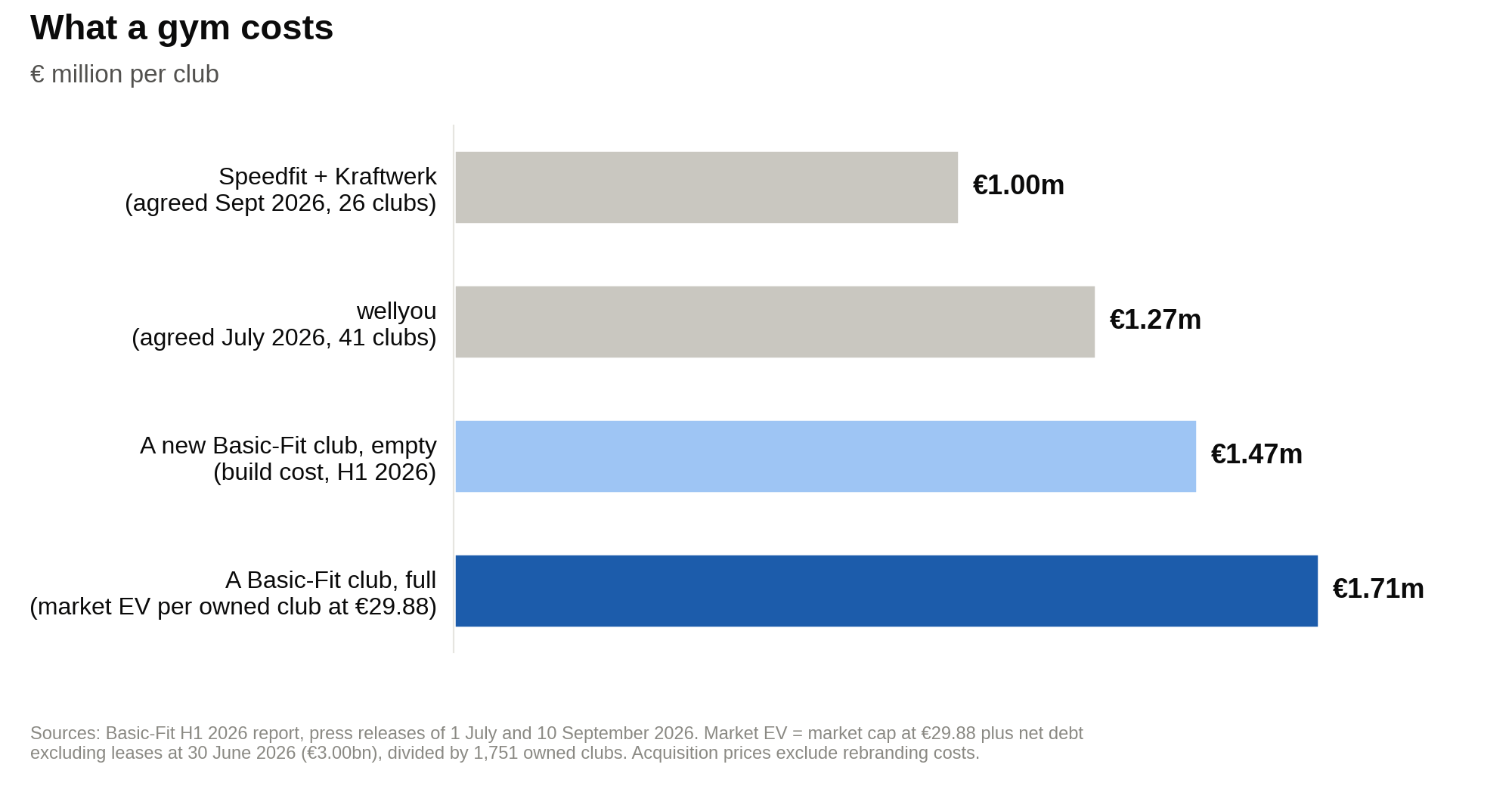
Now run the sum the other way. At €29.88 a share, Basic-Fit’s market value plus its net debt comes to about €3 billion, for 1,751 owned clubs. That’s roughly €1.70 million a club, for clubs that are open, branded, equipped and full: the average one has 2,999 members, about twice the level at which a Basic-Fit club breaks even. Take out the roughly €175 million the company paid for Clever Fit and it’s still around €1.6 million, before giving any value to the 441 franchised clubs.
Either these clubs barely earn their cost of capital, or the market is measuring them with the wrong tool. I think it’s the tool. Basic-Fit’s moat is poorly understood, and EV/EBITDA, the multiple most people reach for, can’t see it.
The cost structure competitors can’t buy
If you think low-cost fitness is one of the least defensible businesses in Europe, you’re in good company. The product is a room full of machines. Anyone can buy the machines, and anyone can rent the room.
What a newcomer can’t buy is the cost structure. Basic-Fit’s clubs break even at 1,400 to 1,500 members, a level the company calls “peer-leading” for big-box gyms. It runs one employee per shift and, where the law allows, no staff at night; France allowed it from May. It builds every club to the same blueprint, negotiates rent with the weight of 1,751 leases behind it, and buys equipment by the thousand. Marketing runs at about 5% of revenue, and the cost of signing a new member is down 9% since 2024.
And the price of getting in keeps rising.
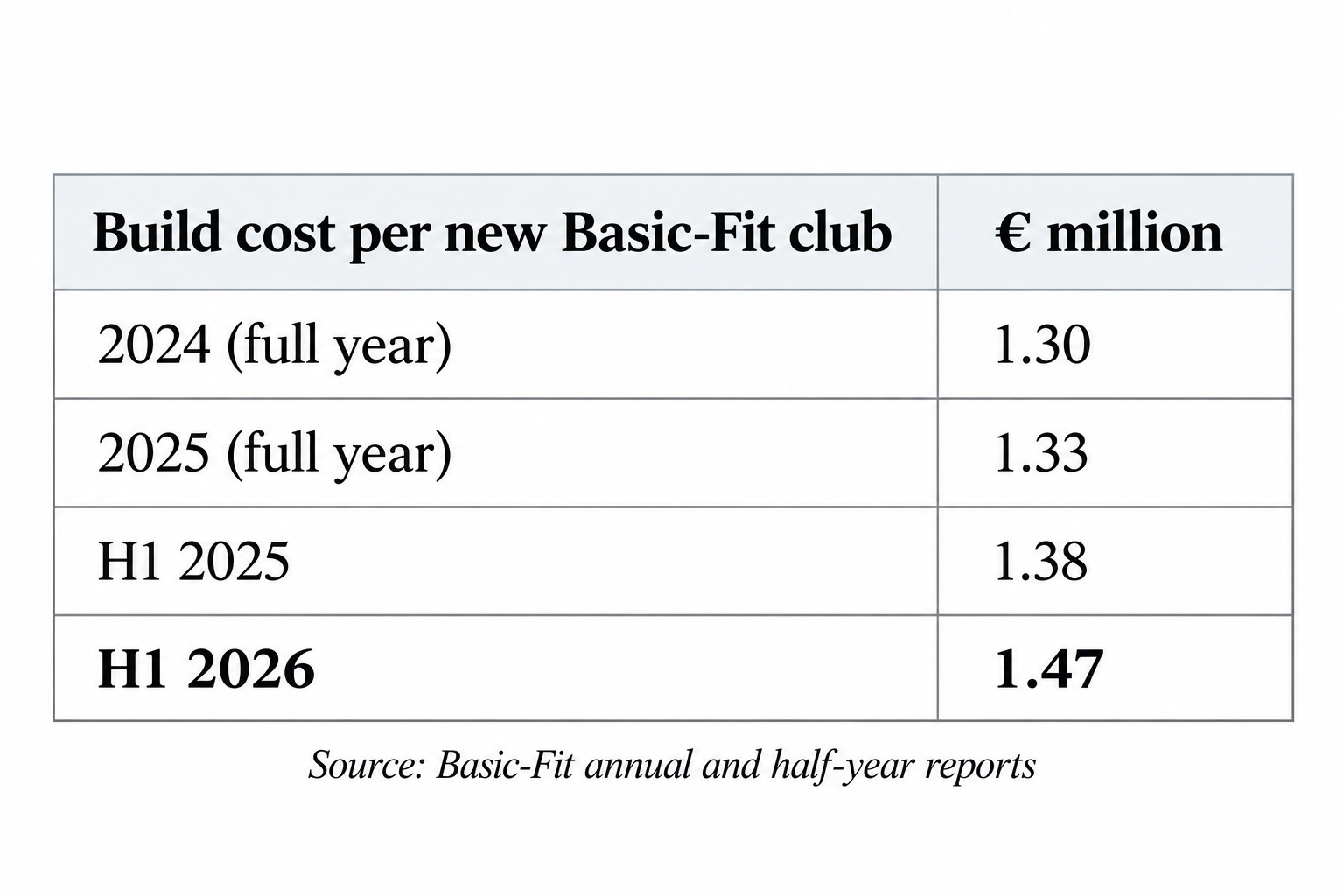
Part of that increase is Basic-Fit’s own choice: bigger clubs and a new design. The rest is construction and fit-out inflation, which everyone pays. The difference is who already owns a network. Basic-Fit built most of its clubs at yesterday’s prices. A new entrant has to finance today’s.
Financing widens the gap. The ECB raised its deposit rate in June and again in September, to 2.50%. A sub-scale operator paying for a €1.5 million fit-out borrows at bank rates plus a premium for having no track record. Basic-Fit’s latest bond, issued in April, was a convertible with a 2.5% coupon, two thirds of its debt is at fixed rates, and it now pays for new clubs out of its own cash flow: €162 million before expansion last year, more this year.
Three clubs, one town
The cost advantage matters most because of what Basic-Fit does with it, and one slide from its 2024 investor presentation explains that better than I can.
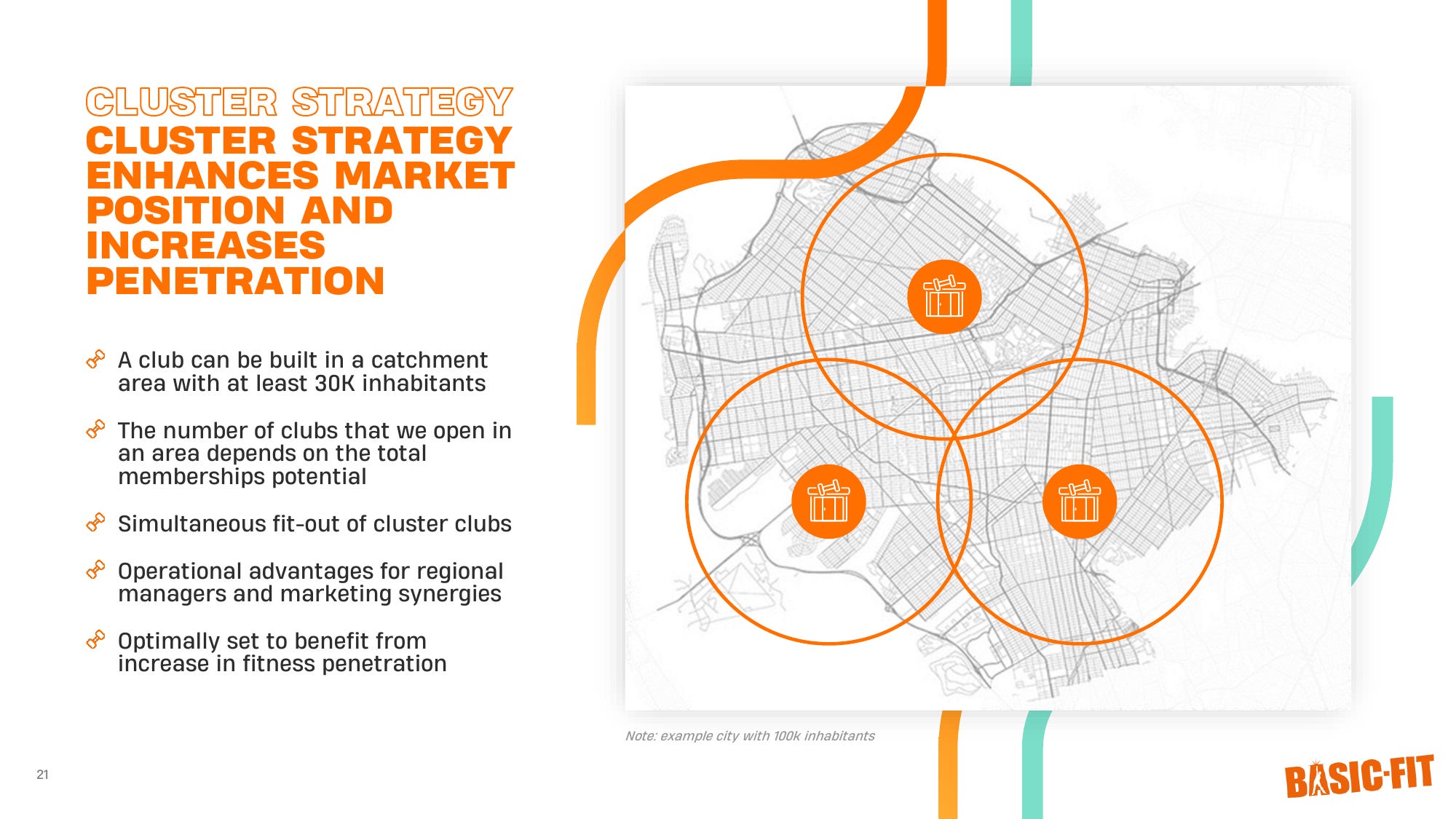
A Basic-Fit club needs a catchment of at least 30,000 people. In a town of 100,000, Basic-Fit doesn’t open one club and wait. It fits out three at the same time, with catchments that overlap, so nobody in town is far from an orange door. Every member can use all three. The regional manager, the local marketing and the construction crew are shared.
Now look at it from the challenger’s side. People choose a gym mostly on how close it is. Wherever the new club goes, its catchment overlaps at least one Basic-Fit, usually two. The members who care most about distance are already signed up, and the rest have a cheaper club nearby. The newcomer needs more members than Basic-Fit to break even, in a smaller pool, having paid more to build. A new Basic-Fit club, meanwhile, signs more than 1,000 members in its first 30 days, a third more than in 2023.
The town isn’t full of gyms. It’s full enough that a fourth one doesn’t pay.
Basic-Fit doesn’t just have a lower cost base. The lower cost base lets it profitably occupy more locations in each town. Those extra locations shrink the pool left for the next entrant, whose break-even is higher to begin with. Cost advantage creates density, and density protects the cost advantage.
Construction inflation doesn’t create that loop. It makes the entrant’s side of it more expensive every year.
What the acquisitions tell us
The clearest evidence is who has been selling clubs to Basic-Fit this year, and at what price.
In July, Basic-Fit agreed to buy wellyou: 41 clubs in northern Germany for €52 million, or €1.27 million a club.
In September, it agreed to buy Speedfit, 18 clubs and “one of the larger independent fitness operators in Austria”, plus eight Kraftwerk clubs in Germany, for €26 million in total. About €1.0 million a club.
Both deals came in below the €1.47 million it costs to build a club from scratch, members included. The Kraftwerk clubs average about 1,250 members, below Basic-Fit’s break-even. Speedfit’s clubs average about 2,000.
You could read that the other way. If gyms change hands below replacement cost, a rival can buy capacity instead of building it, and the construction barrier falls away. That would be true if a club were worth the same in anyone’s hands. It isn’t, and Basic-Fit has already run the experiment at scale:
After buying 42 McFit clubs in Spain in 2024, Basic-Fit lifted revenue per club by 43%, underlying EBITDA by 52% and members per club by 60%.
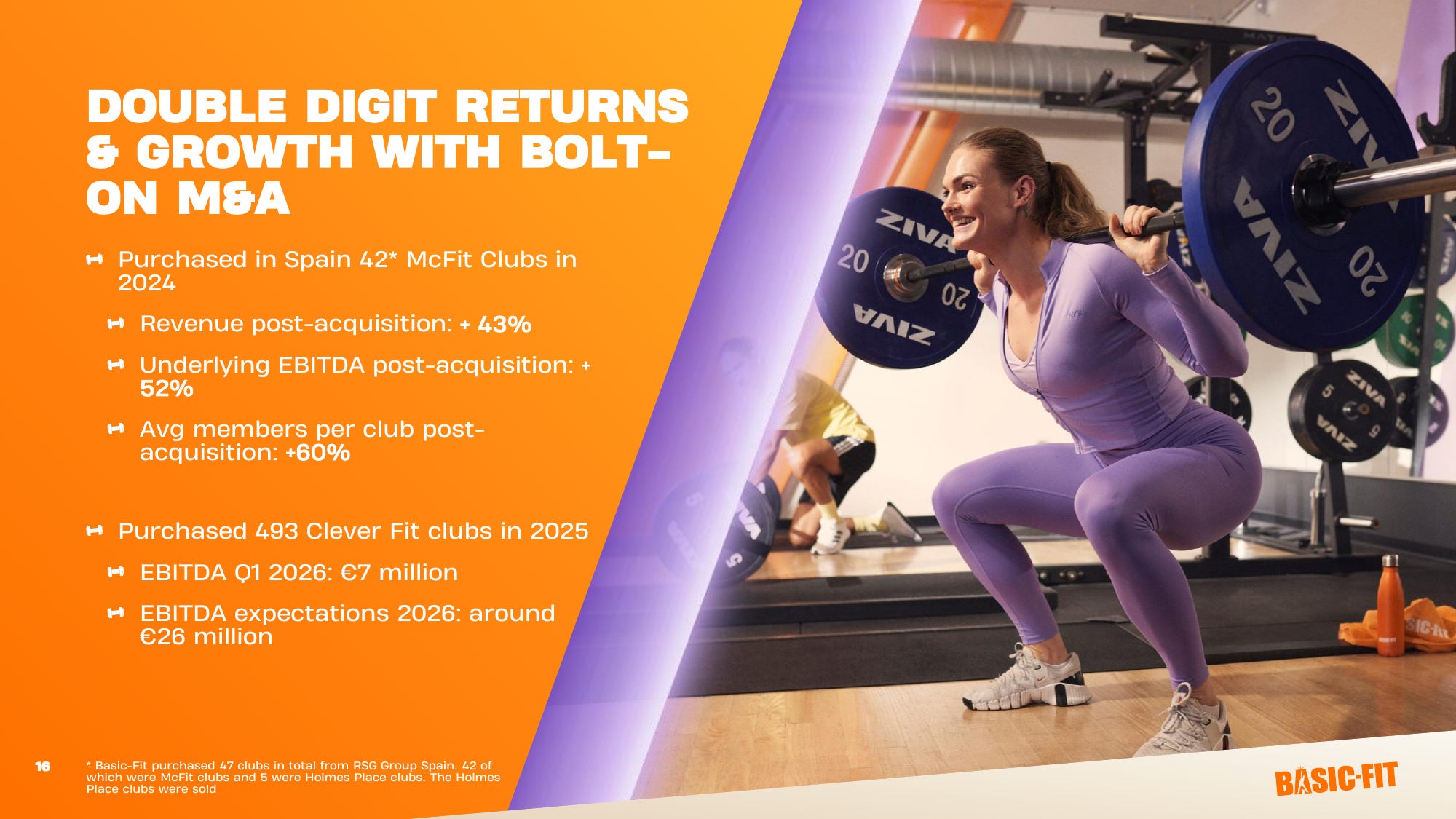
Same buildings, same towns. New sign, new pricing, Basic-Fit’s systems. Management expects the same from this year’s deals: once Speedfit and Kraftwerk are rebranded, it says their profitability should “converge with the Group’s average.”
A gym is worth more with an orange sign on it than without one. The barrier isn’t the concrete. It’s the network that makes the same concrete earn more.
The bill that comes with it
There is an obvious problem with my argument. If construction inflation makes the moat wider, it also makes the clubs more expensive to maintain.
The treadmills, floors and showers replaced in year eight are the same ones you’d buy for a new club. You can’t count the first inflation as a moat and ignore the second.
Basic-Fit’s record here is mixed. Its 2023 annual report expected maintenance spending per club “to remain at around €55 thousand through 2030.” It was €58 thousand in 2024 and €60 thousand in 2025, and about €60 thousand is guided for 2026. Over the same period the build cost rose to €1.47 million, so maintenance fell from 4.5% of what a new club costs to 4.1%. I don’t love that gap, and it matters more as the estate gets older.
Some of it is by design. The 2025 annual report describes a component approach: base equipment depreciated over 12 years, replacement parts over six to eight, routine repairs expensed through operating costs. Part of the upkeep already sits inside EBITDA less rent. And at about 7% of revenue, Basic-Fit spends on maintenance roughly what The Gym Group does, and more than SATS (5.8%) or Smart Fit (4.8%).
The sums are modest too. Had maintenance kept pace with build costs, it would be about €66 thousand a club: around €11 million a year across the estate, 2.5% of this year’s guided EBITDA less rent. At €85 thousand, 40% above today’s level, the hit is about €44 million, a tenth. The moat survives its own maintenance bill, but anyone who extends the moat’s life in a model has to extend the bill with it. The piece I’d watch is the upkeep that runs through operating costs, which never shows up in the capex line and which Basic-Fit doesn’t break out.
Why EV/EBITDA can’t see this
Most of what I read on Basic-Fit comes down to one number. The bulls say about 6x EBITDA against 10 or 11x for peers, so it should re-rate. The bears say 6x is cheap because capex eats everything. I think both are arguing about the wrong line. Here’s where Basic-Fit’s EBITDA went in 2025, using only the company’s own figures.
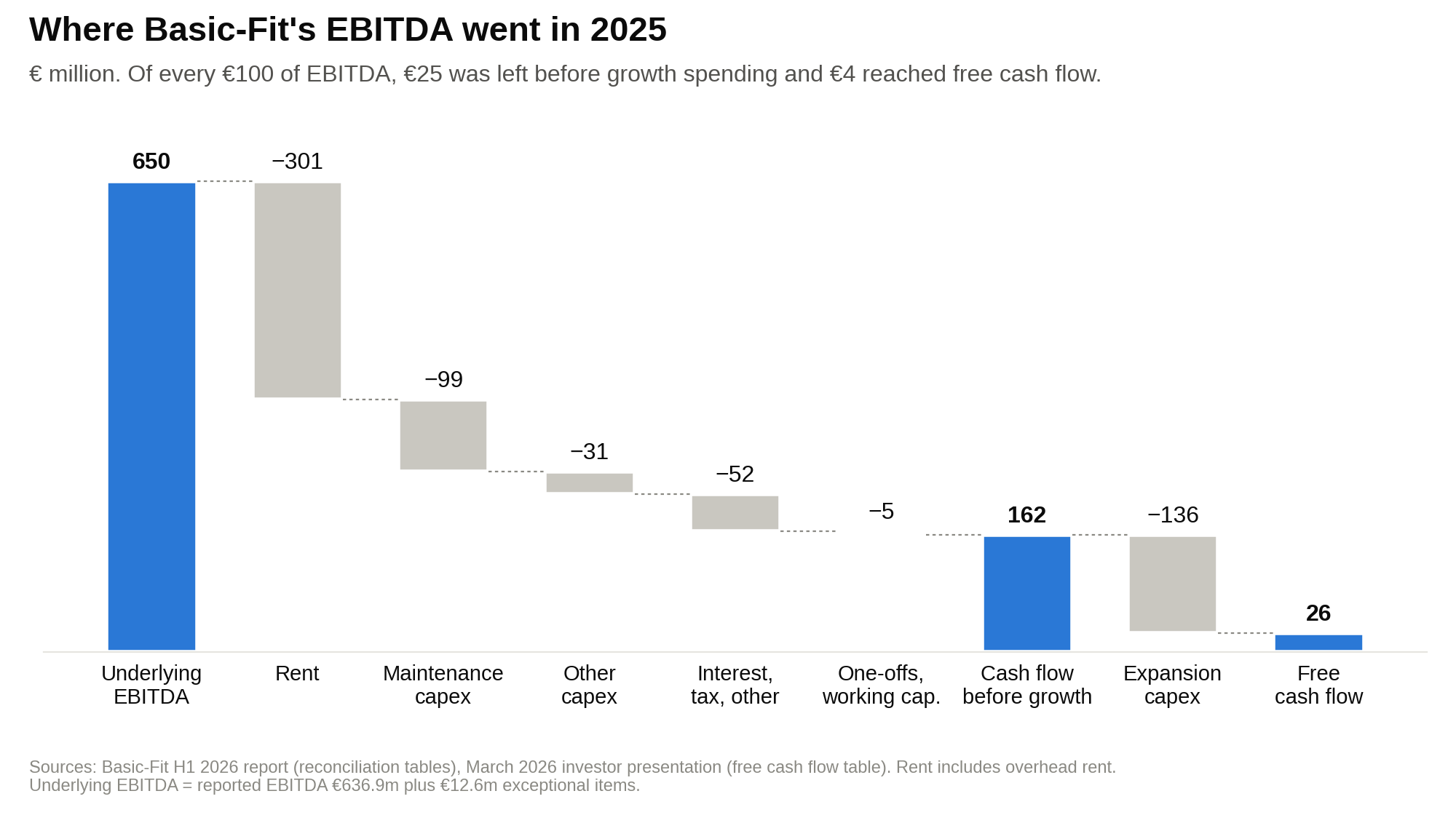
Of every €100 of EBITDA, €25 was left before growth spending and €4 reached free cash flow.
Rent. Under IFRS 16, about €300 million of annual rent moves below EBITDA and €1.86 billion of lease liabilities move into enterprise value. Nothing about the business changes; the ratio does, and two chains with the same economics but different lease lengths end up on different multiples.
Maintenance. EBITDA never sends you the bill for replacing the treadmill. At Basic-Fit that bill takes 28% of EBITDA less rent.
Depreciation. Basic-Fit writes its clubs off fast, over about 12 years on average. That doesn’t touch EBITDA or cash, but it flattens reported profit, so the same stock looks cheap on EV/EBITDA, at 6.3x, and expensive on earnings, at more than 40x trailing.
None of these numbers says anything about durability, and durability is what a moat is.
Freeze the estate
A moat is what lets a company stop spending on growth without the cash flow melting.
So the test I use is simple: what does Basic-Fit earn if it never opens another club? About 90% of the estate is mature or will be by the start of 2027. On my numbers, free cash flow would be around €200 million in the first year and rise as the last clubs fill. For reference, the company’s own cash flow before expansion was €162 million in 2025, and this year’s guidance adds about €100 million of EBITDA less rent. At €29.88, that’s a yield of roughly 10% on the equity, for a network competitors can’t cheaply copy.
Basic-Fit won’t freeze, of course. New clubs earn mid-teens returns once mature, McFit shows acquired clubs can get close to that, and the runway is long: Basic-Fit holds about 6% of the German market, where only 16% of clubs belong to a major chain. Whether management captures that value, or gives some of it back through mediocre acquisitions while its own shares may be the better buy, is a separate question. Management ranks returning capital to shareholders last of four uses of cash. I’ll take that on in the next note, together with a letter I plan to send to the board.
What would change my mind
Pricing. A low-cost moat is a cost moat, not pricing power: it holds only as long as Basic-Fit stays the cheapest. The metric that showed whether it was protecting that position was fitness revenue per member, which it stopped reporting separately with its H1 2026 results. I’d like it back.
Integration. If wellyou and Speedfit don’t start to look like McFit once rebranded, the acquisition evidence above weakens. The first numbers come through in 2027.
Maintenance against build cost. If the cost of a new club keeps rising while maintenance stays at €60 thousand, something is being deferred or moved into operating costs.
Next checkpoint: the Q3 trading update on 21 October.
Conclusion
The moat is real. The harder question is whether shareholders will capture all of it.
I own Basic-Fit because I like the economics of the existing estate. I haven’t made it a large position because I’m less certain about what happens to the cash that estate will generate.
Basic-Fit has four choices: open clubs, buy competitors, pay down debt, or buy back its own shares. At today’s price, I don’t think those choices are remotely equivalent.
That’s Part 2. I’ll put a return on each one—and then send one of the conclusions to Basic-Fit’s Supervisory Board.
À bientôt,
Guillaume
Disclosure: I own BFIT shares (small position). Figures and prices are as of 25 September 2026. This is not investment advice.
Sources
Basic-Fit: Half-Year Report 2026; Annual Report 2025 (note 4.3); Annual Report 2023; Capital Markets Day presentation (21 April 2026); investor presentations (March 2024, March 2026); press releases of 1 July, 12 August and 10 September 2026.
European Central Bank, key interest rates.
The Gym Group, SATS and Smart Fit 2025 annual reports (maintenance capex).
Market data as of 25 September 2026.