
Disclosure: I initiated a position in Copa Holdings (NYSE: CPA) shortly before publishing this article. Forward estimates in this article are my own.
In the second quarter, Copa Holdings (NYSE: CPA) paid 85% more for jet fuel than a year earlier. It does not hedge. Operating margin fell from 21.7% to 8.7%.
Then it raised fares and kept growing.
Yield rose 8.7%. Capacity rose 16.5%. In July, load factor reached 89.7%. The shares, meanwhile, fell more than 20% from their June high to $126.45 at the end of August.
If you think you already know how this airline story ends, look at July.
I bought Copa for one reason: the current fuel shock is testing the Panama network in real time, and so far the network is repricing faster than the market seems to believe. The risk is equally simple: 46 incoming MAX deliveries could turn a good airline into an ordinary one.
THE INVESTMENT IN ONE SCREEN
Quality: 22.6% operating margin in 2025 - more than three times the global airline industry - and a three-year ROIC averaging 16.7%.
Fuel test: Roughly 64% of the higher guided fuel cost is already reflected in guided unit revenue.
Valuation and risk: The middle of my 2027 range produces roughly $17-$21 of EPS, or about 6-7x earnings; 46 incoming MAX deliveries could push capacity beyond what the network can absorb.
I listened to eight consecutive earnings calls, from Q3 2024 through Q2 2026, and read the filings, traffic releases and Investor Day material alongside them. The calls matter because last year’s ROIC tells you what the old fleet earned. They tell you how management behaves when Boeing is late, Argentina gets over-served, fuel doubles and forty-odd aircraft are still coming.
A seller can make a coherent case. Copa’s recent margins benefited from a supply-constrained post-Covid region. Fuel has now delivered the first serious stress test in years and quarterly margins collapsed into single digits. Management responded by raising 2026 capacity guidance from 11-13% to 14-15%. That is exactly how good airline economics usually end: strong returns invite capacity, capacity weakens pricing, and the industry gives the economics back.
I think that reading misses what is happening underneath the headline margin.
The quality is real. The cash cost of growth is too.
Copa earned $818.9 million of operating profit in 2025 on $3.62 billion of revenue, a 22.6% operating margin. Applying the company’s 13.4% effective tax rate gives $709 million of NOPAT. I define invested capital as equity plus borrowings plus aircraft lease liabilities and, deliberately, I do not subtract the cash pile. On average 2024-25 invested capital of $4.73 billion, I get a 2025 ROIC of about 15%.
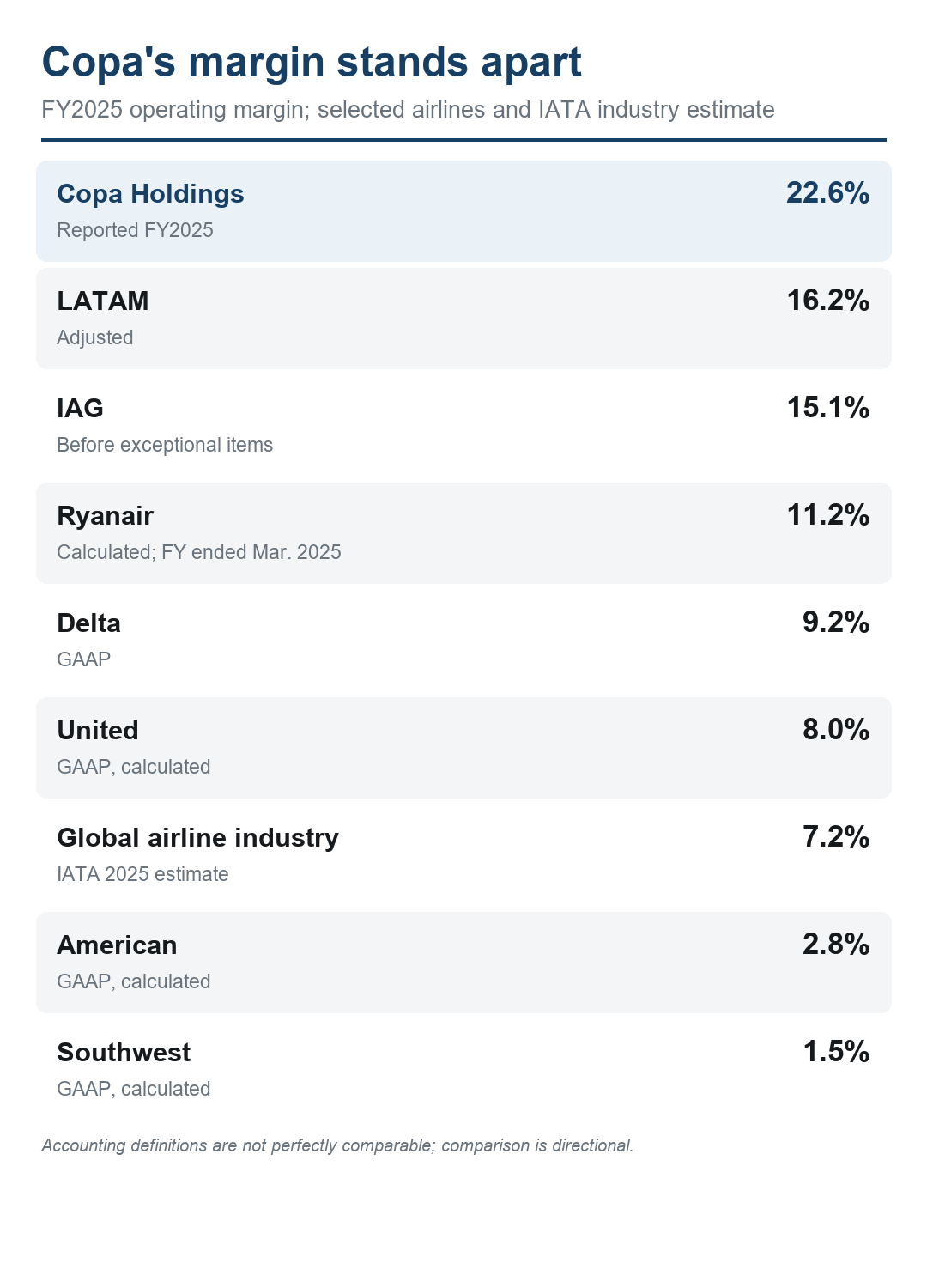
Even allowing for those basis differences, the gap is hard to miss. Copa finished 2025 above LATAM and IAG, and its 22.6% operating margin was a little more than three times the IATA estimate for the global airline industry.
Margins are only the first test. The harder question is whether those profits survive the capital required to produce them.
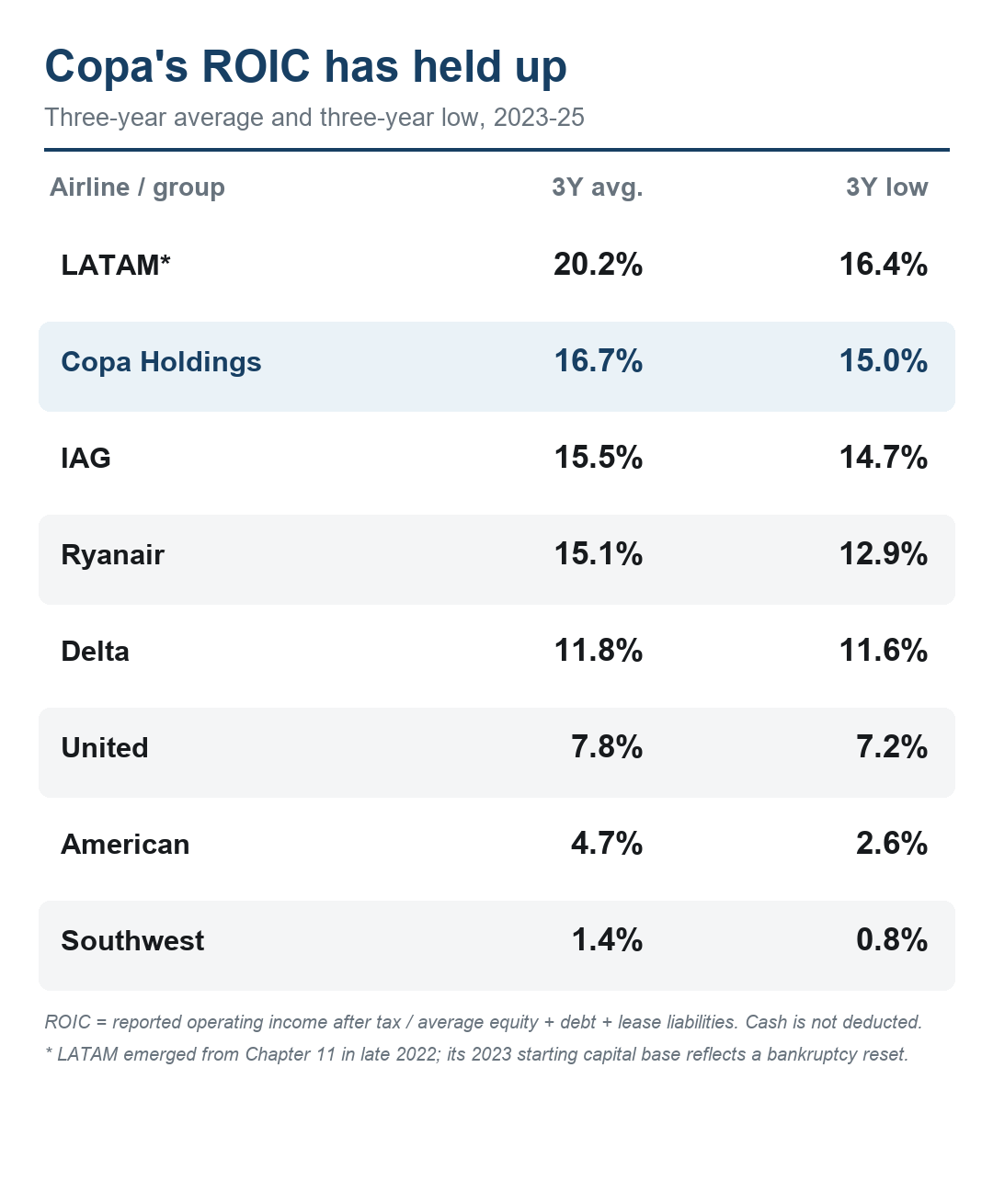
Copa does not rank first, and that is useful context. LATAM screens higher, while IAG and Ryanair are also excellent operators. What stands out is Copa’s floor: on this deliberately conservative measure, ROIC never fell below 15% in any of the last three years.
Keeping cash in invested capital matters. Netting out liquidity pushes ROIC above 20%, but an airline cannot sensibly run without a large buffer. Fuel shocks, recessions, airport closures and aircraft groundings are not theoretical risks. Some of that cash is operating capital in disguise.
ROE was stronger again: $671.6 million of net income against average equity of $2.57 billion, or about 26%. This is not leverage pretending to be quality. Copa finished 2025 at 0.6x adjusted net debt/EBITDA.
Cash conversion is less glamorous. Operating cash flow was $1.15 billion in 2025, but aircraft purchases, pre-delivery payments and intangibles consumed about $953 million. Free cash flow after all aircraft investment was only $197 million by my calculation. In 2024 it was about $501 million and in 2023 about $443 million.
The next aircraft matters more than last year’s ROIC.
Copa can still compound value while consuming capital. It simply has to earn a high enough return on the capital it keeps putting back into the fleet. That is a harder test than pointing to one year’s accounting margin, and it is the test 2026 is starting to answer.
The moat is the hub
Calling Copa the Panamanian flag carrier is technically correct and economically misleading. Panama is too small to explain the airline. The product is connectivity between other cities in the Americas through Tocumen.
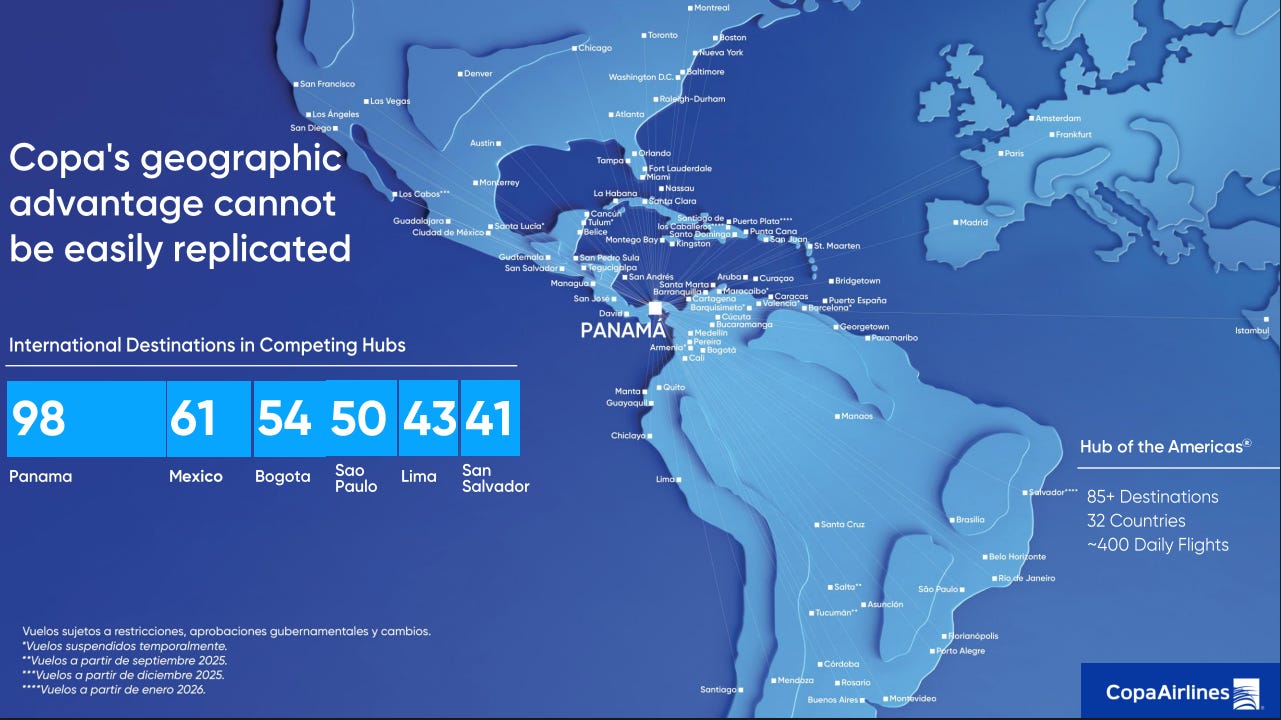
Source: Copa Holdings, 2025 Investor Day.
Panama lets Copa aggregate thin demand across a network that has been built up over decades.
Copa says the hub offers nonstop or one-stop service across more than 5,000 city pairs. At Investor Day, management showed that about 80% of the origin-destination combinations in its network have fewer than 20 passengers a day in each direction. Those markets are usually too thin to support convenient nonstop service.
Panama solves the density problem. Copa can collect passengers from dozens of origins, connect them through one banked hub, and redistribute them across dozens of destinations. The aircraft are replaceable. The accumulated network is not.
A third-party OAG schedule analysis of about 120,000 Copa flight frequencies makes the pattern more concrete. In the 9M26 schedule, 69% of routes were Copa-exclusive. Among the 67 routes where frequency was increasing, 82% were exclusive and Copa’s ASM share was about 88%. On the routes where capacity was being cut, its share was closer to 53%. Competitor capacity was also falling on the contested routes where Copa was adding seats.
Those route statistics are useful; the calls show how management behaves when conditions change. Argentina became one of Copa’s strongest markets, competitors piled in, and yields softened. Pedro Heilbron did not argue that the moat made supply irrelevant. He said Copa would not be growing there as much as it had over the prior year. That is the behavior I want from an airline manager: move the airplane.
Panama also keeps the operating model simple. At June 30, all 131 aircraft in the fleet were Boeing 737 variants. One narrowbody family covers most of the Americas from a centrally located, sea-level hub. Crew training, maintenance, spare parts and scheduling are simpler than at a multi-fleet network airline.
That simplicity shows up in ex-fuel CASM: 5.8 cents in 2025 and 5.7 cents in 2Q26 despite the 16.5% capacity increase. Copa gets much of the revenue opportunity of a connecting network while retaining a relatively simple narrowbody cost base.
Panama’s tax regime helps too. Income from Copa’s foreign operations is generally outside Panamanian income tax, while traffic originating or terminating in Panama is taxed under the local rules. The consolidated effective tax rate was 13.4% in 2025. That tax treatment amplifies the returns already created by the network.
Independent research on overlooked businesses and mispriced securities.
Subscribe free to receive the next deep dive.
What the next aircraft cost
This is where the story becomes dangerous. At Investor Day, Copa showed 46 MAX deliveries scheduled from 2026 through 2029. In April 2026 it added another 40 firm MAX orders plus 20 options for 2030-34. An order book is not a moat. It is a claim on future capital.
Across the last eight calls, the near-term deliveries look less frightening. In Q3 2024, Boeing delays forced Copa to plan less growth than management thought demand could support. By Q1 2025, management described the airline as “tight in capacity.” When deliveries caught up, much of the 2026 growth was not speculative route creation: management said about half came from the full-year effect of capacity already added in 2025, around 10% from new destinations, and the rest mainly from extra frequencies and utilization.
Management has since raised the 2026 plan to 14-15%, so the old 11-13% decomposition cannot simply be copied forward. What matters is that management re-explained the higher number after the raise rather than changing the story. Boeing delivered earlier, utilization improved, and demand was still there.
Fleet flexibility is better than the gross delivery count suggests. Older 737-700s can be retired instead of sent through expensive heavy checks. Leases can roll off. Delivery slide rights exist. Aircraft can be sold. Copa’s Investor Day downside case showed how an 8% planned fleet CAGR through 2029 could fall toward 2.5% if demand weakened.
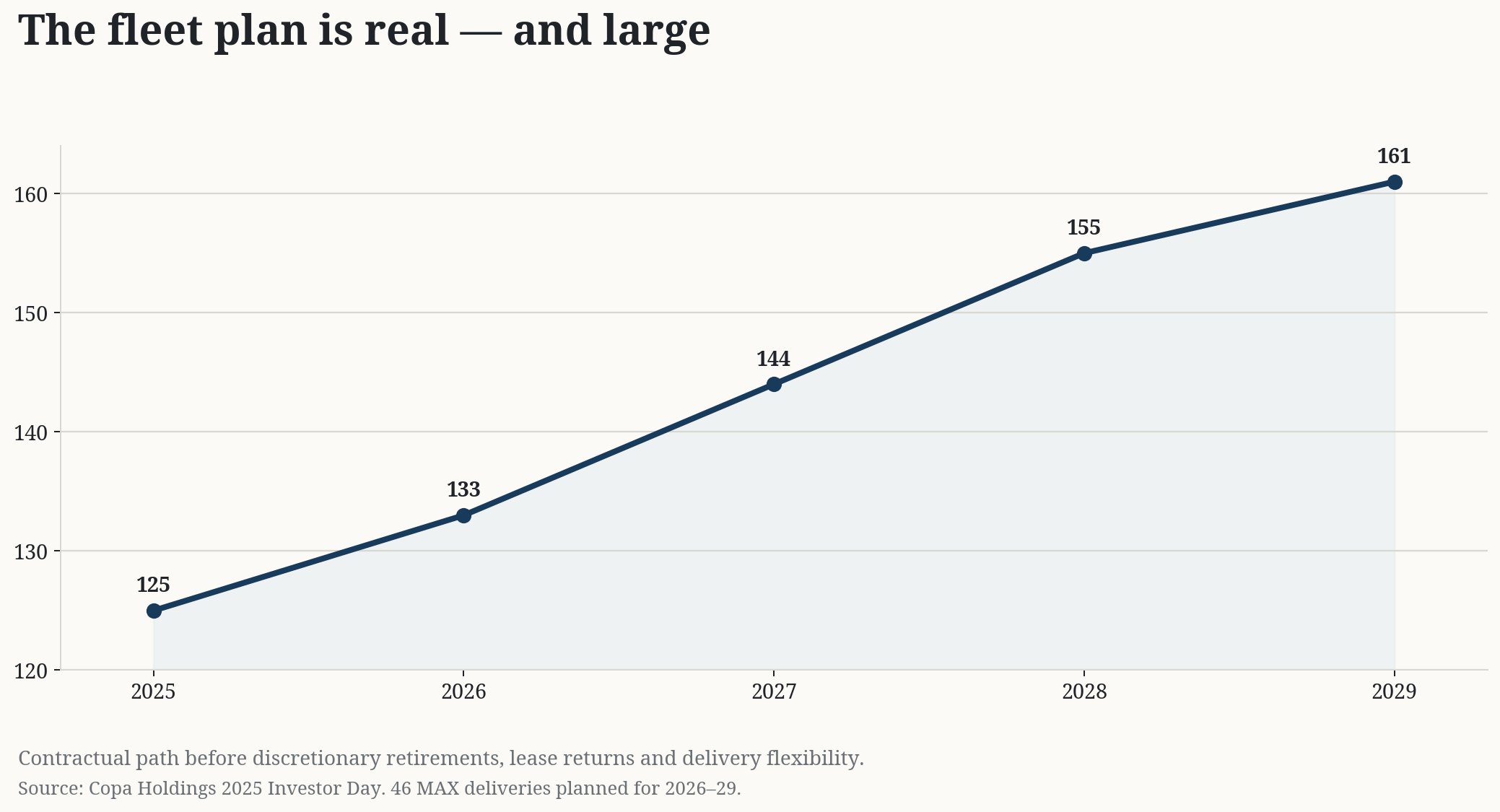
Newer aircraft also improve the economics. MAX 8s drive most of the near-term capacity increase in the OAG schedule work and burn materially less fuel than the 737-800s they replace or supplement. Gallons per ASM are improving even while the headline fuel price gets worse.
Management has aircraft coming. It also has exits.
That does not guarantee discipline. The 2030-34 order tells us management believes the runway is long; it does not tell us management is right. But so far the evidence looks more like delayed growth being unlocked than airplanes searching for somewhere to fly.
The fuel test
Copa does not hedge fuel. In 2Q26 the all-in fuel price jumped from $2.32 to $4.28 per gallon. Fuel expense more than doubled, and operating margin fell into single digits. The pass-through mechanism is therefore visible in almost real time.
Q2 was messy because many tickets had been sold before the shock. Copa still lifted RASM 7.9%, raised fares sharply and kept ex-fuel unit costs essentially flat. Management estimated that higher revenue recovered about 40% of the incremental fuel cost during the quarter.
Full-year guidance tells a cleaner story. In February, Copa guided to $2.50 fuel, 11.2-cent RASM and a 22-24% operating margin. By August, fuel guidance had risen to $3.60 and RASM to 12.0 cents, while the operating-margin range fell to 17-19%.
Using recent fuel burn per ASM, the $1.10 increase in guided fuel price adds about 1.25 cents of fuel cost per ASM while RASM guidance rose 0.80 cents. That puts implied full-year pass-through at about 64%. Fleet mix and stage length move the exact figure, but most of the shock is already showing up in higher unit revenue.
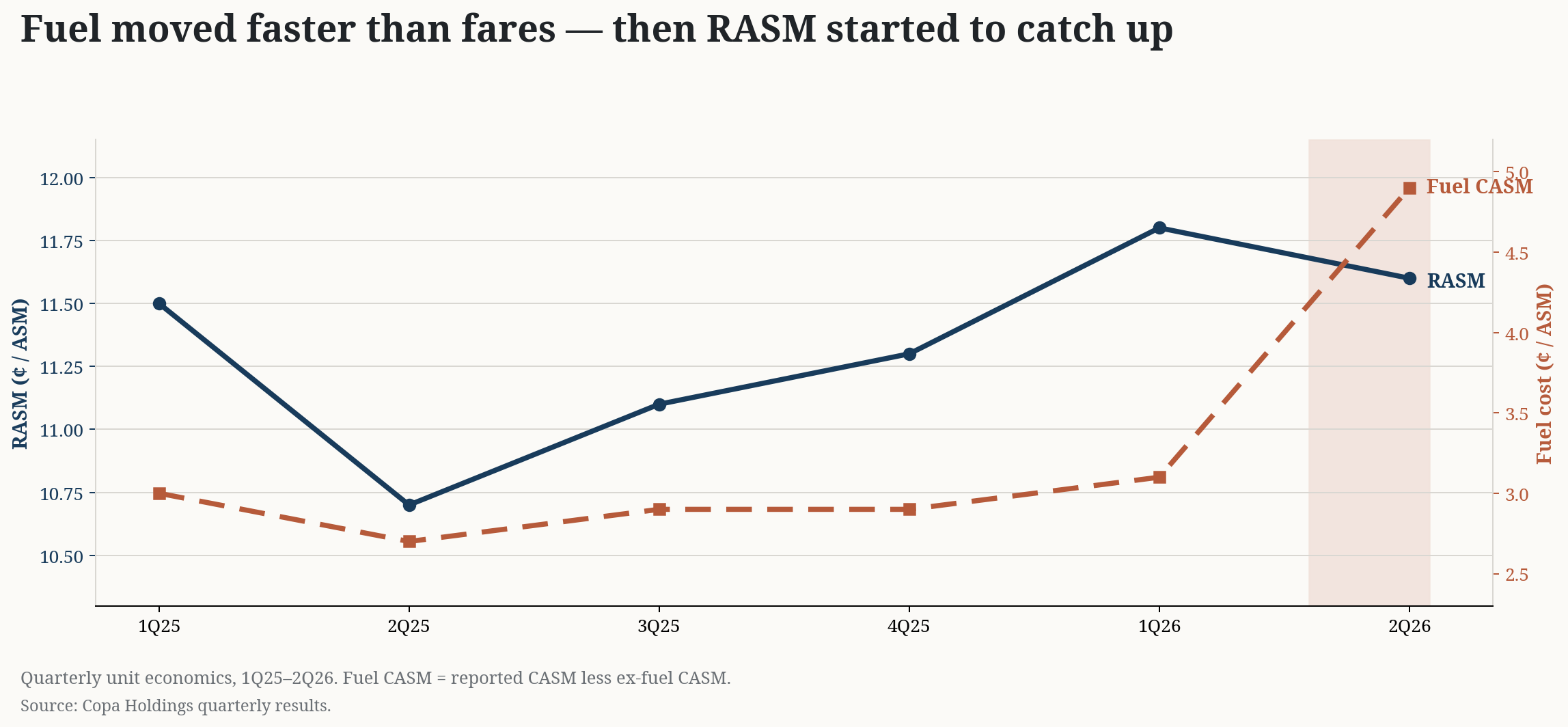
Booking timing gives pricing more room from here. Management said only about 20% of Q3 had been sold before the fare increases and almost none of Q4. By the August call, around 75% of Q3 and 25% of Q4 were sold. Management also described competitors as showing “a lot of discipline” after fuel moved.
Then came July: capacity +16.2%, traffic +17.4%, load factor 89.7%. Heilbron said that near-90% load factor was being achieved in a higher-yield environment.
A high load factor alone proves very little. You can fill an airplane by cutting the fare. What matters here is the combination: capacity is up, yield is up, RASM is up, and utilization remains high.
There is upside if fuel falls and some of the pricing sticks. Management argues that yields entered the shock below 2019 levels even before adjusting for inflation. I do not need that outcome in the base case, but it creates an interesting asymmetry: high fuel gives Copa more time to reprice; lower fuel could restore margin faster if fares are slow to give back.
Self-help between the aircraft
Some of Copa’s improvement does not require another airplane. Direct and NDC channels reached 89% of sales by Investor Day, up from about 60% in 2022, while sales-and-distribution expense per ASM fell about 30%. That is self-help, not a fuel-cycle gift.
Ancillary revenue grew at a 34% CAGR from 2019 to 2025 versus about 4% capacity growth between those endpoints. The base was small, so I would not turn Copa into a loyalty-program story. Still, more revenue per passenger is exactly what a capital-intensive business needs.
Copa is also densifying the 737-800: more seats per aircraft while keeping a conventional business-class cabin and Economy Extra. Lower unit cost without abandoning the premium product.
A bigger operational change arrives in March 2027, when Tocumen moves from six daily connecting banks to eight. Management calls the change a RASM improver and a CASM detractor. The denser schedule should create more connection options and improve aircraft utilization, but it adds schedule complexity and cost. The economic test is whether the revenue gain beats the CASM drag.
Tocumen also has physical headroom. The airport is adding gates and apron/runway capacity alongside the bank redesign. A growth thesis built around one hub needs the airport to keep up.
Reliability is part of the product too. Copa reported 90.75% on-time performance in 2025. At a connecting carrier, a late inbound is not merely irritating; it can break two legs of the itinerary. The hub only works if the banks connect.
This is what the cash is for
Copa ended 2Q26 with $1.54 billion of cash and investments and adjusted net debt/EBITDA of 0.9x. An unhedged airline in a fuel spike should be holding cash. This is what the cash is for.
Aircraft commitments are still real. At year-end 2025, contractual aircraft and engine commitments net of discounts and PDPs were $0.2 billion for 2026, $0.5 billion for 2027, $0.9 billion for 2028 and $0.4 billion for 2029, with more thereafter. Copa finances aircraft through a mix of operating cash flow and long-term aircraft financing.
Copa’s dividend policy targets up to 40% of the previous year’s underlying consolidated net income, subject to Board approval. The current annualized payment is $6.84 a share. That exact payment should not be assumed for 2027 because the 2026 fuel hit flows into the next dividend decision.
Earnings and operating cash flow cover the payout, but free cash flow after today’s heavy aircraft investment does not. That is acceptable while the growth capital earns good returns. It becomes a problem if the new fleet is merely keeping reported growth alive.
Copa repurchased $45 million of stock in Q1 and then stopped as the fuel environment deteriorated. I read that as prudence. Fuel had just become the dominant uncertainty, the airline remained unhedged, and dozens of aircraft were still being funded. Preserving liquidity in that moment is consistent with the balance-sheet discipline that makes Copa unusual in the first place.
Two variables, not one
My first valuation pass made Copa look cleaner than it really is. I used a 22% 2027 operating margin, which produced about $21 of EPS. The arithmetic worked. The assumption was hiding in the margin: with 12-cent RASM, a 22% margin effectively needs fuel around $3.20 a gallon.
It was a fuel forecast wearing a margin assumption.
For an unhedged airline, the honest way to underwrite the earnings is to put fuel and RASM on the page together.
For the table below I assume 39.7 billion 2027 ASMs: 2025 actual capacity, 14.5% growth in 2026 at the midpoint of guidance, then 7% in 2027. Ex-fuel CASM stays at 5.7 cents, fuel burn is 1.14 gallons per 100 ASMs, net financial expense is $50 million, the tax rate is 13.5%, and the share count is 41 million. Those operating assumptions are mine.
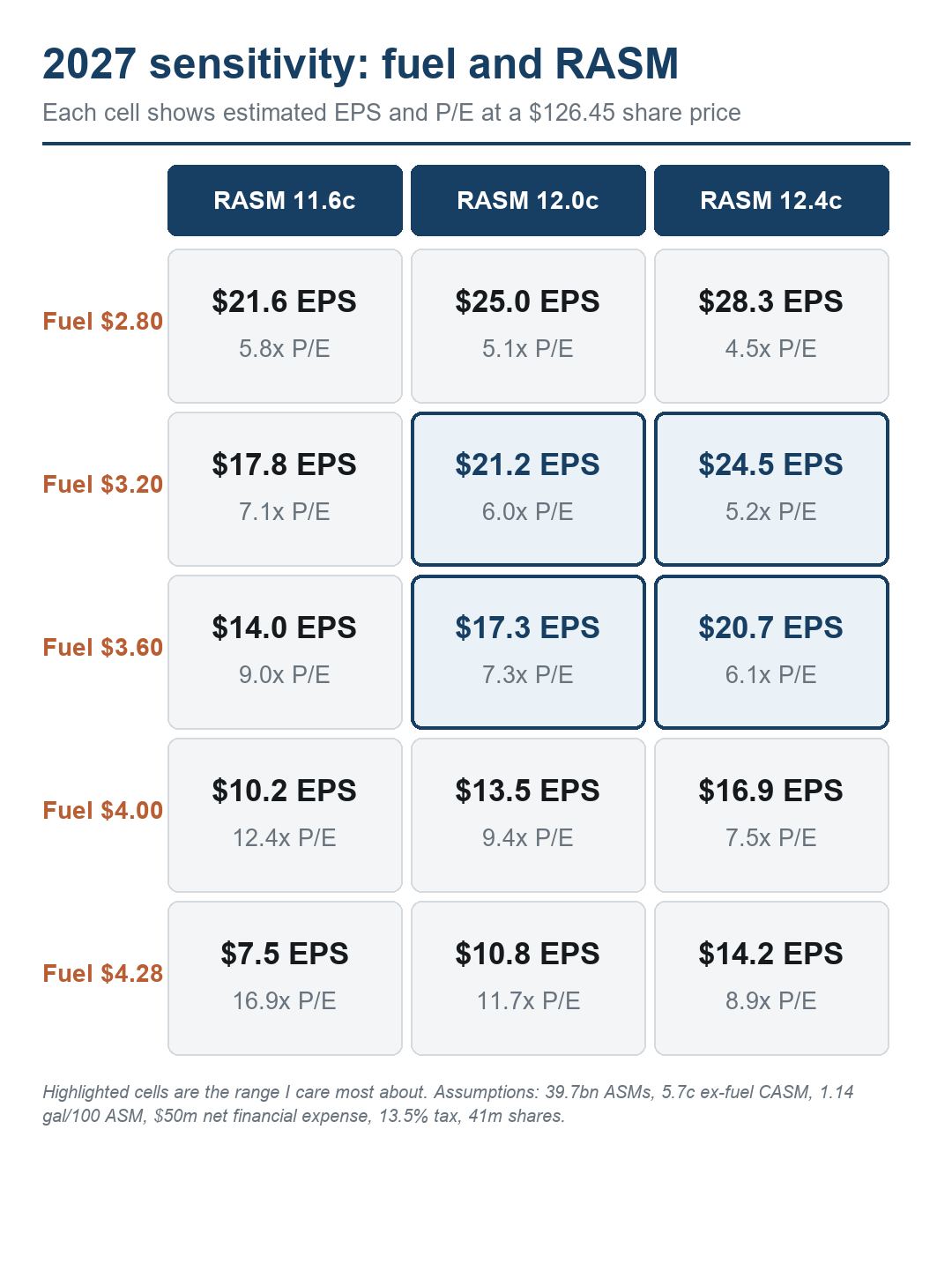
Six times earnings is one cell, not the thesis.
I start the RASM columns at 11.6 cents rather than 2025’s 11.2. Copa already guides to 12.0 cents for 2026 at $3.60 fuel. If fuel remains $4-plus into 2027, continued repricing is more plausible than an immediate return to pre-shock fares.
That 6x outcome now sits where it belongs: visible and conditional. At 12.0-cent RASM and $3.20 fuel, I get about $21.2 of EPS. At Copa’s current $3.60 fuel assumption and the same RASM, the model gives $17.3 and 7.3x earnings. If repricing pushes RASM to 12.4 cents at $3.60 fuel, EPS rises to $20.7 and the multiple falls to 6.1x.
This is why the equity can still work without a heroic multiple. Depending on the RASM/fuel combination, plausible normalized cases sit in a wide band. The market is not offering a free lunch. It is offering a cheap claim on the spread between unit revenue and fuel.
I do not know which cell we will land in. I do not think I need to. Enough of the middle of the table works for me.
Every 0.1 cent increase in ex-fuel CASM costs about $0.84 of EPS in this model, all else equal. The eight-bank redesign therefore has to earn its keep. So do the aircraft.
If Copa can grow earnings at a healthy rate and return a meaningful share of profits, a static 7-8x multiple can still produce attractive shareholder returns. A rerating is optionality.
What breaks it
One ugly quarter does not break the thesis. A sustained change in the operating evidence would.
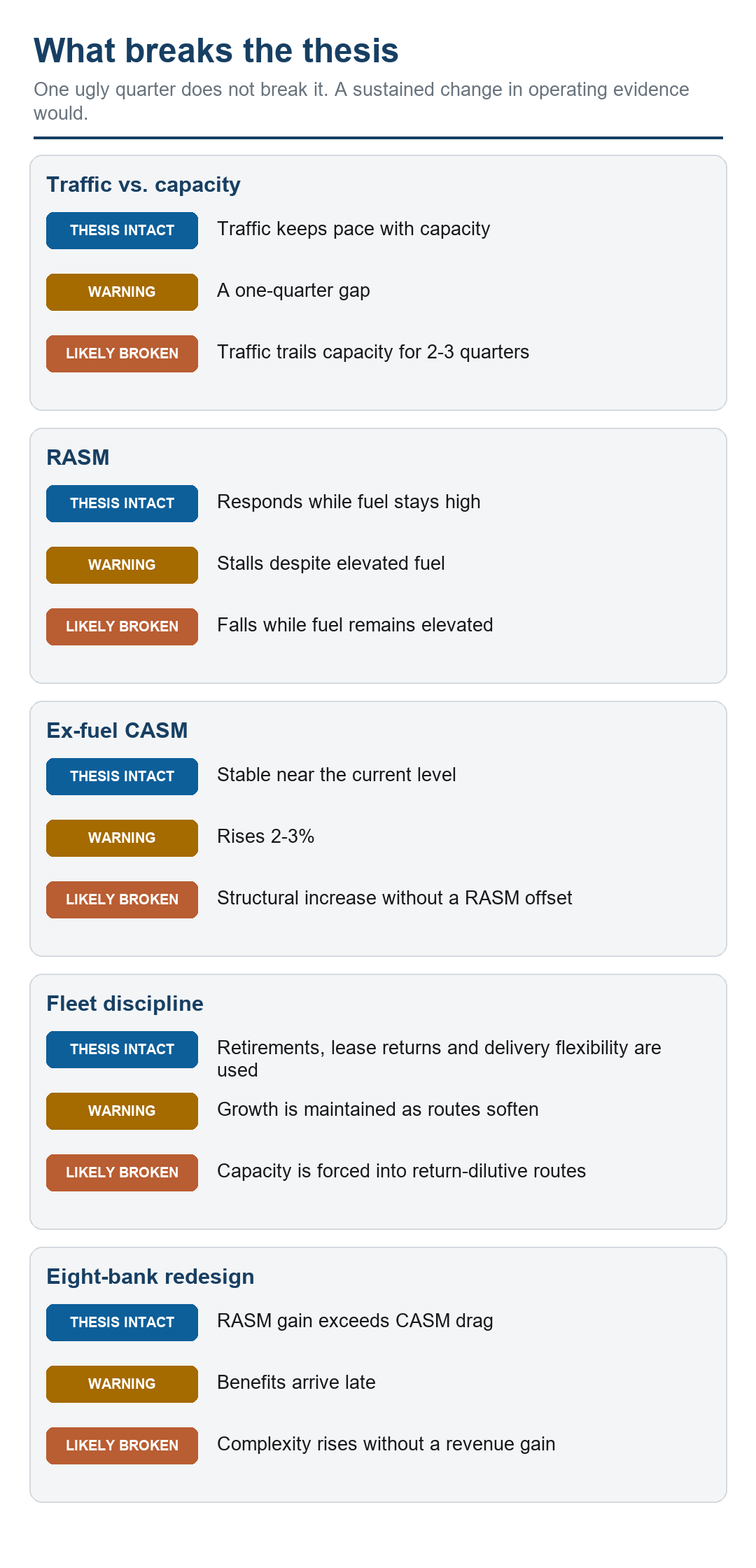
Boeing concentration sits on top of all of them. All 131 aircraft are 737s. Fleet simplicity is a cost advantage until a technical or regulatory problem affects the family again.
That is why I bought the stock. The operating evidence still points the right way: Copa is adding a lot of capacity, charging more, and filling the airplanes. Management has also shown that it will pull back when a market gets crowded. The balance sheet gives it time to be patient.
I do not need Copa to become a wonderful business. I need it to remain a good one.
If the Panama network can keep repricing fuel, absorb 6-8% long-term capacity growth and earn something close to mid-teens incremental returns, the valuation does not need much help from multiple expansion. If it cannot, RASM and load factor should tell us before reported ROIC does.
The next aircraft matters more than last year’s ROIC.
Independent research on overlooked businesses and mispriced securities.
Sources and notes
Source integrity: Reported figures are traced to company or regulatory sources where available. The route-level schedule statistics are third-party calculations built from OAG data. Forward estimates are my own.
Results and latest traffic evidence: Copa Holdings - 2Q26 Financial Results; July 2026 Traffic Statistics.
Audited financials, tax, cash flow, debt, aircraft commitments and fuel policy: Copa Holdings - 2025 Form 20-F.
Network density, fleet flexibility, distribution, ancillary growth and hub infrastructure: Copa Holdings - 2025 Investor Day.
OAG-based 9M26 route and schedule analysis - third-party calculations using approximately 120,000 Copa flight frequencies.
Original earnings calls, Q3 2024 through Q2 2026: Copa Holdings - Earnings-call archive.
Fleet composition: 2025 Form 20-F; 2Q26 Financial Results.
April 2026 order for 40 firm 737 MAX aircraft plus 20 options: Copa Holdings - 1Q26 Financial Results.
February versus August 2026 guidance: 4Q25 and FY2025 Financial Results; 2Q26 Financial Results.
2025 on-time performance: Copa Holdings - 4Q25 and FY2025 Financial Results.
FY2025 airline operating-margin comparison - primary sources: Copa | LATAM | IAG | Ryanair | Delta | United | American | Southwest | IATA
Three-year ROIC comparison - my calculations from the companies’ annual reports and filings. Methodology: reported operating income after tax divided by average equity plus interest-bearing debt plus lease liabilities; cash is not deducted.
$45 million share repurchase: Copa Holdings - 1Q26 Financial Results.
Valuation model: assumptions are my own; company operating inputs are calibrated to reported 2025/2026 capacity, fuel burn, guidance and share count. Primary calibration source: Copa Holdings - 2Q26 Financial Results.
This article is for research and discussion, not investment advice. Airline earnings are highly sensitive to fuel, demand, capacity, foreign exchange, regulation and aircraft availability. My estimates may be materially wrong.