
Helios Towers is not a telecom operator. No phone plans. No spectrum. No smartphones. It does not even own the radio equipment that sends the signal.
Instead, Helios owns the boring part: the towers.
And sometimes the boring part is where the money is made.
A mobile operator needs towers to provide coverage. But owning towers is capital-intensive, operationally messy, and inefficient if every operator builds its own mast in the same location. The better model is shared infrastructure. One company owns and operates the tower, and several mobile network operators rent space on it.
That is the towerco model.
In developed markets, tower companies such as American Tower and SBA Communications became extraordinary compounders for a simple reason. The first tenant pays for most of the economics. The second and third tenants can be added at very high incremental margins: the mast is standing, the land is leased and the power system already exists. Adding another customer is not free, but it is wonderfully profitable.
Helios applies this model in Africa and the Middle East, where mobile infrastructure is still far from mature. It owns roughly 15,000 towers, is listed in London and, at 192 pence per share, has a market value of about £2 billion.
One detail caught my attention. In May, the company raised its full-year guidance across the board. Since then, the shares have fallen about 17% from their spring high. Fundamentals up, price down. That gap is what this article is about.
A real estate business disguised as telecom infrastructure
I find Helios easier to understand as a landlord than as a telecom company.
Its tenants are mobile operators. Its properties are towers. Its rents are long-term contracts, typically 10 to 15 years in these markets, non-cancellable, with inflation and power-price escalators. Its growth comes from two sources: building or acquiring more towers, and adding more tenants to the towers it already owns.
This is why the REIT analogy is useful.
Helios is not a REIT, and the contracts are not pure triple-net leases. But economically, it has several REIT-like characteristics: long-term contracted revenue, inflation-linked rent escalators, mission-critical assets, and high visibility. The order book alone is $5.3 billion of signed future revenue, with around 70% of it owed by investment-grade counterparties and more than 70% of EBITDA earned in hard currency.
The difference is that a good tower becomes more profitable as more tenants are added.
A building with one tenant can be risky. A tower with one tenant is just the starting point. Add a second tenant, and the economics improve dramatically. Add a third, and the returns can become excellent.
This is the key to the entire investment case.
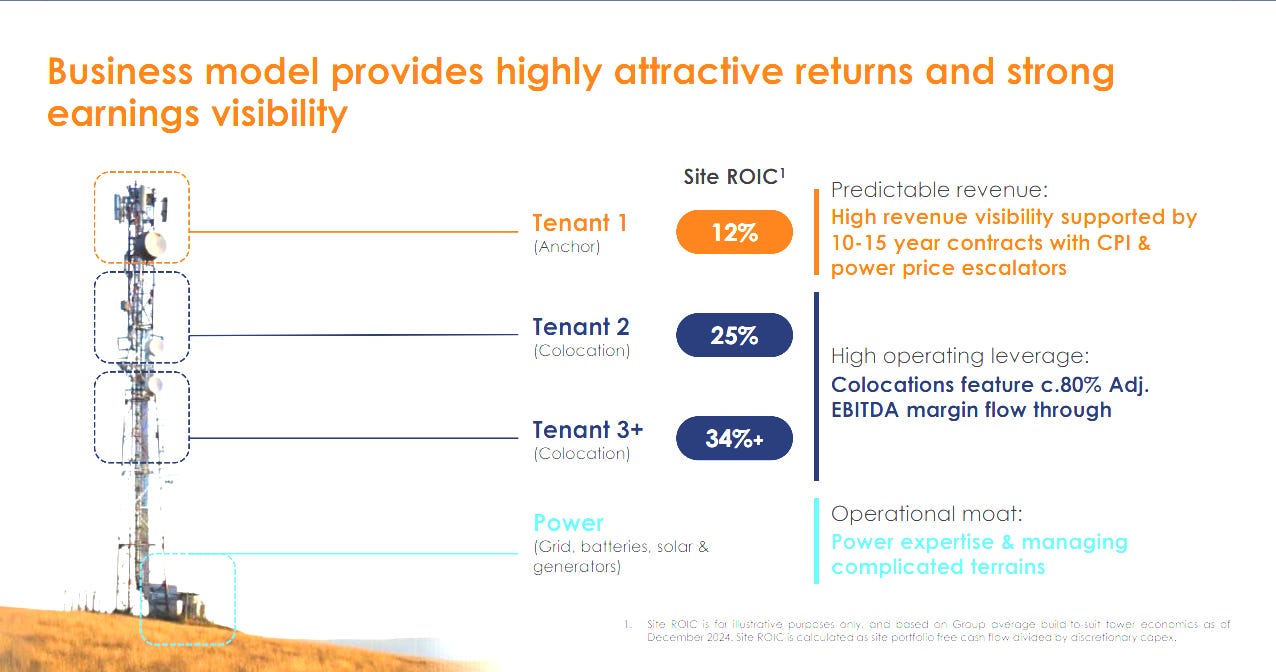
Helios’s tenancy ratio is 2.2x, with a company target of 2.5x by 2030. That means the average tower already hosts more than two tenants, but still has room to improve. Each additional tenant does not require building a new tower from scratch. It uses infrastructure that is already in place.
The company’s own investor presentations spell out the operating leverage. A new site earns around 12% ROIC with just its anchor tenant. Add a second tenant and returns jump to roughly 25%. With three or more, they exceed 34%. Same mast, same land, same power.
Slow at first. Then powerful.
Why Africa changes the equation
The growth case is not hard to understand. The harder part is believing the market can ignore it for this long.
Africa has very low fixed-line broadband penetration. In the US and Europe, most internet data travels through fixed-line networks. In many African markets, there is no equivalent fixed-line infrastructure. The mobile network is not a convenience. It is the network.
That means more people, more smartphones, more data usage, more 4G, more 5G, and more mobile broadband all point in the same direction: more demand for towers.
Tower density across Helios’s markets remains far below global averages, and subscriber penetration sits near half of European levels. The market data the company itself cites points to 94 million new mobile connections and a quadrupling of data traffic across its footprint over the next five years, requiring more than 28,000 new points of service. On top of that, roughly 19,500 towers in its markets are still owned by the operators themselves: a ready-made pipeline of future sale-and-leaseback deals. Data traffic across Africa and the Middle East is forecast to grow faster than in any other region for the rest of the decade, and sub-Saharan Africa’s population is growing at several times the pace of the developed world.
I am not buying this for the next quarter. The bet is that Africa’s mobile network buildout still has many years to run.
And Helios is not just promising growth. It is delivering it. In the first quarter of 2026, revenue grew 12%, EBITDA grew 14%, and management raised full-year guidance, including a record 3,000 to 3,500 new tenancies for the year.
What went wrong the first time
The early bulls on this stock were not wrong. They were early.
The stock struggled for years because Helios had too much debt, too much perceived emerging-market risk, and too little visible free cash flow.
Investors looked at the story and saw the growth. But they also saw leverage above 5x EBITDA, rising rates, political risk, currency risk, and heavy capex. That is not a combination the market was willing to reward. From its 2019 IPO at 115p, the stock touched nearly 190p, then collapsed below 70p by late 2023.
The company has moved from “interesting growth asset with a balance sheet problem” to a business that funds itself and returns cash.
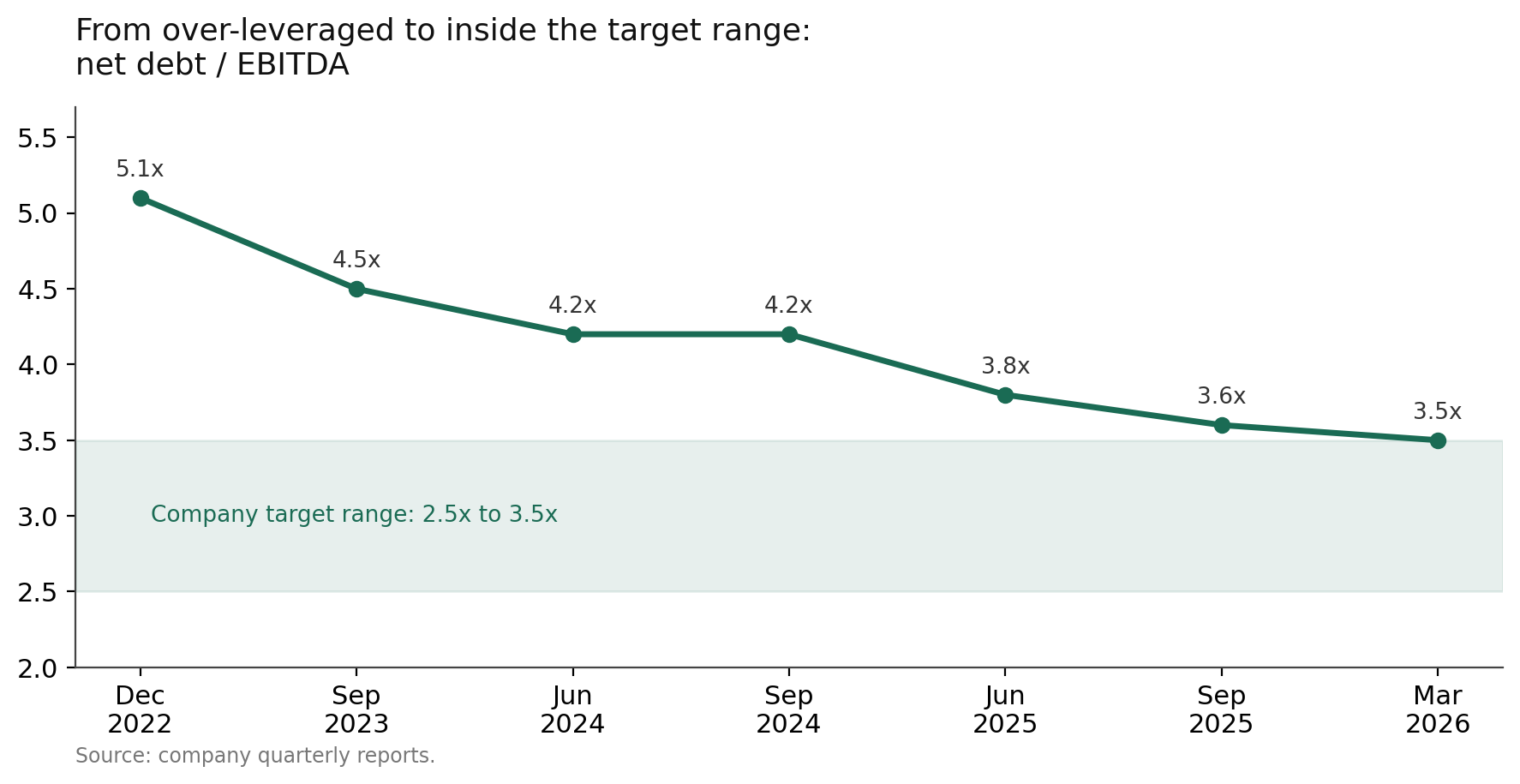
Net debt/EBITDA has fallen from a peak of 5.1x at the end of 2022 to 3.5x today, and the company is guiding it toward the bottom of its 2.5x to 3.5x target range.
At 5x leverage, investors worry about survival, refinancing, and rates.
At 3x, they start thinking about buybacks.
Helios has crossed that bridge.
The free cash flow inflection
The most important recent development is free cash flow.
For years, Helios looked optically expensive on traditional free cash flow because it was still investing heavily. But that headline number hid the quality of the underlying tower estate.
Helios itself reports a metric called recurring free cash flow, or RFCF. This is not the same as normal free cash flow. It is closer to “cash generated by the existing estate after leases, maintenance capex, cash taxes and interest, but before discretionary growth capex.”
That distinction matters.
If Helios builds new towers, reported FCF can look modest because the cash is being reinvested. But if the new towers earn attractive returns, that is not a weakness. That is exactly what I want them to do with the cash.
The cash machine is finally working. Helios burned through nearly $80 million as recently as 2023. This year it is guiding for $215 to 230 million of recurring free cash flow, and that guidance was raised in May. The company’s own five-year plan points to more than $1.3 billion of cumulative recurring free cash flow between 2026 and 2030. That is roughly half of today’s entire market capitalisation.
The market used to ask: “When will Helios generate cash?”
Now the question is: “What will Helios do with the cash?”
The answer comes from the company’s own November 2025 Capital Markets Day targets: new sites, dividends and buybacks. EBITDA growth above 9% a year to 2030. A maiden dividend of about $25 million this year, targeted to grow to more than $150 million annually by 2030. And over $250 million of buybacks, which have already started and are already shrinking the share count.
That is the virtuous circle.
Falling leverage enables capital returns. Capital returns improve investor confidence. Investor confidence can reduce the discount rate. A lower discount rate can re-rate the equity. Meanwhile, the underlying business continues to grow.
Why the valuation still looks strange
Helios has already performed well. Over twelve months the shares are up more than 60%. This is no longer the forgotten 2023 opportunity.
But the valuation still looks odd.
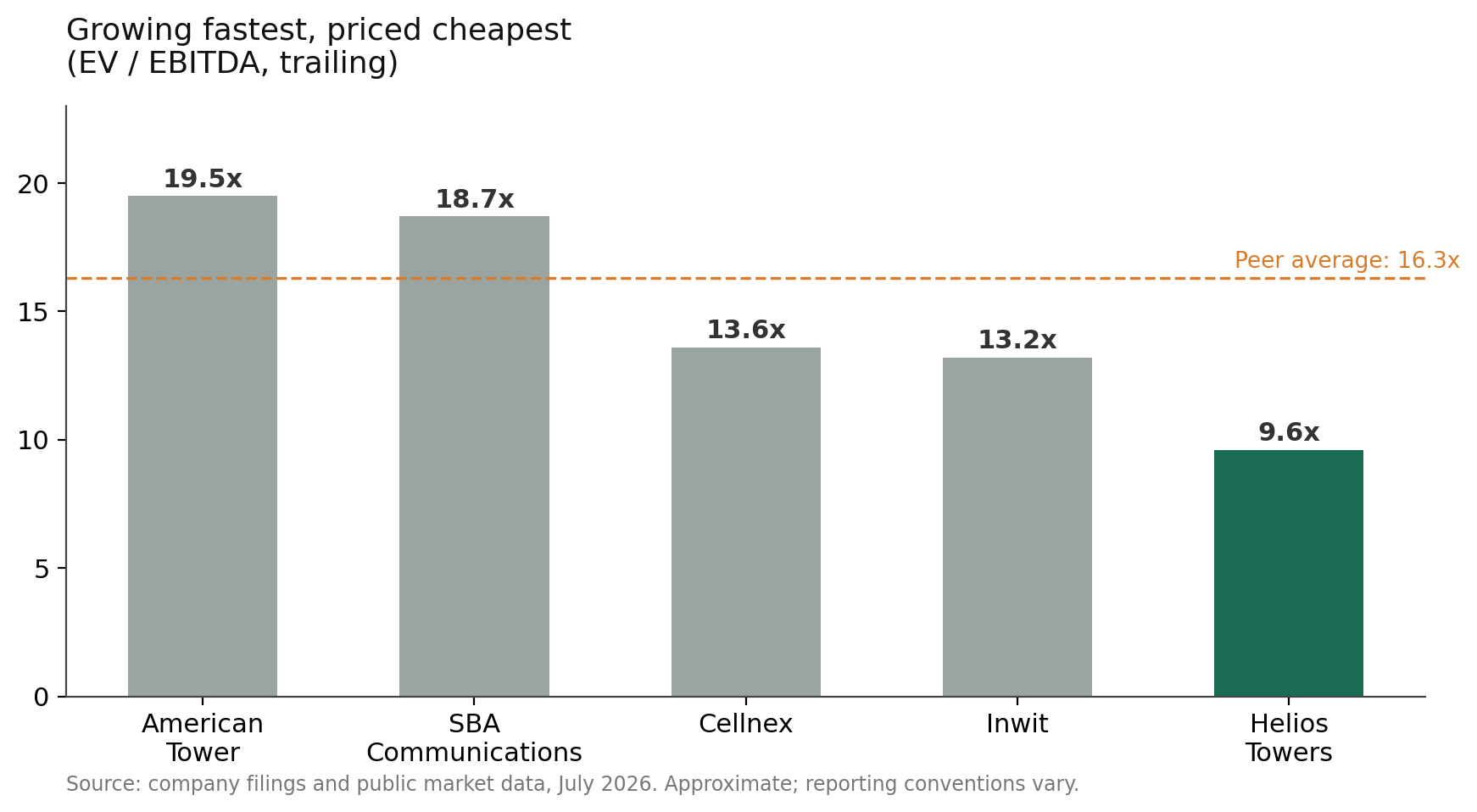
At around 192p, the enterprise value is roughly $4.5 billion. That is under 10 times trailing EBITDA, and under 9 times this year’s raised guidance. Extend the company’s own 9%-plus growth target two more years, and it is roughly 7 times 2028. Listed tower peers trade between 13 and 20 times trailing EBITDA. Helios trades below 10 times, while growing faster than any of them.
This is where I struggle with the current price.
This is an infrastructure business with long-term contracts, inflation-linked revenues, structural growth, improving margins, falling leverage, and buybacks. Yet it still trades at a material discount to listed tower peers.
Some discount is fair. Helios operates in more complex markets. Political risk, FX risk and customer concentration are real. It should not trade at the same multiple as American Tower.
But should it trade at half the multiple while growing faster?
That is the question.
More importantly, I do not need a heroic re-rating for the investment to work.
Suppose the multiple never moves. EBITDA compounds at the company’s targeted 9% or better, so at a constant multiple the enterprise value grows at the same pace. Net debt is flat to falling, which means the equity grows faster than the enterprise value. Add a dividend yield above 1% and rising, plus a share count shrinking from buybacks, and you get a low-teens annual return with the multiple going nowhere. A partial closing of the peer discount would be welcome, but it is dessert, not dinner.
There is also a new scarcity angle. In February, MTN, Africa’s largest mobile operator, agreed to take IHS Towers private at a $6.2 billion enterprise value. The deal has not yet closed, but once it does, Helios becomes the last listed pure-play on African towers. Anyone who wants this exposure through public markets will have exactly one option. And in a consolidating sector, the only remaining public company is also the only remaining public target.
My view is that the market is still anchored to the old Helios: high leverage, negative FCF, emerging-market risk, no shareholder returns.
The new Helios is different: lower leverage, positive FCF, accelerating EBITDA, organic growth, and capital returns.
The rerating may have started, but it does not look finished. And the recent pullback has widened the gap again: the shares are down about 17% from the May high, in the same quarter that guidance was raised.
The moat
The moat is not technology. There is nothing magical about a metal tower.
The moat is location, contracts, economics and operational capability.
Once a tower exists in the right location, building another one nearby usually makes little economic sense. The second tower would split the same pool of demand while requiring new land, permitting, power, security and maintenance. The incumbent tower has the advantage because it can add another tenant at high incremental margins.
In African markets, power is also part of the moat. Running towers reliably in difficult environments is not trivial. Backup power, batteries, diesel, solar, logistics and security all matter. Telecom operators would rather focus on customers, spectrum and networks than manage thousands of distributed power sites.
That is why tower outsourcing exists.
And that is why scale matters.
Helios was not built in a vacuum, either. Its founding backers in 2010 included the IFC, the World Bank’s private-sector arm, alongside George Soros’s Quantum fund, Madeleine Albright’s investment firm and RIT Capital Partners. Development finance and sophisticated private capital showed up early, precisely because mobile infrastructure was one of the few African infrastructure categories where the economics were tangible. That history matters. It partly explains why the company has been able to refinance, issue debt, and attract global shareholders despite operating in markets many investors still avoid.
What could go wrong
The risks are real.
First, Helios operates in countries with higher political, regulatory and currency risk. The Democratic Republic of Congo, its largest market, has knocked the stock before. More than 70% of EBITDA in hard currency softens the blow, but the local-currency tail is real, and a cheap multiple is partly justified.
Second, the customer base is concentrated. No single customer exceeds 28% of revenue, but a handful of large operator groups still pay most of the rent. If a major one weakens, delays payment, or reduces capex, Helios’s growth could slow.
Third, capital allocation matters. If management chases M&A too aggressively, the market could again worry about leverage.
Fourth, rates matter. Tower companies are long-duration infrastructure assets. Higher discount rates hurt valuations. That is what crushed this stock in 2022, and it would hurt again.
Fifth, satellites. Starlink is live in a growing number of African markets, and the obvious question is whether low-orbit satellites make towers obsolete. I do not think so. Satellites solve rural coverage, not urban capacity. The cost per gigabyte is not competitive for mass-market mobile data. And operators increasingly use satellite links as backhaul for remote towers, which runs through this infrastructure rather than around it. But it is a technology risk worth watching, and I would rather name it than pretend it does not exist.
Finally, the market may keep applying an emerging-market discount for longer than bulls expect.
This is not a risk-free compounder.
But it may be a misunderstood one.
The thesis in one paragraph
I own Helios because it controls the towers carrying African mobile data in markets where the mobile network is often the only network, under contracts that behave much like high-quality infrastructure leases. The bull case was early for years because leverage was too high and free cash flow was not yet visible. Today, leverage is falling, cash flow has inflected, dividends and buybacks have started, and the company still has years of new sites, new tenants and rising margins ahead of it. The stock has rerated, but at under 9 times this year’s EBITDA it still looks too cheap for a business expected to compound EBITDA at double-digit rates while returning capital to shareholders. And if the multiple never moves, the growth, the dividend and the buyback still do the work.
The old thesis was “one day this could become a great infrastructure compounder.”
The updated thesis is simpler:
That day may have arrived.
Half-year results land on 30 July. The numbers to watch: tenancy additions against the raised guidance, and leverage continuing down toward 3x. I will be watching. You should too.
À bientôt.
Ticker: HTWS (London Stock Exchange). ISIN: GB00BJVQC708. Share price at time of writing: about 192p (delayed quote, 9 July 2026); market cap about £2.0bn / US$2.7bn. Sources: company results, investor presentations and Capital Markets Day materials at heliostowers.com, plus public market data.
Disclosure: I own shares in Helios Towers. This article is for information only and is not investment advice. Emerging-market infrastructure carries significant currency, political and liquidity risk. Do your own research.