

The one-paragraph version
Imperial Brands is one of the simplest ideas in the market right now. It is a mature tobacco business that throws off a lot of cash, returns nearly all of it, and keeps buying back stock at a rate that is hard to ignore. At the current run-rate, the company is set to return roughly £2.7bn to shareholders: about £1.27bn of dividends plus a £1.45bn buyback, against a market value of about £18.6bn at 2,443p. That is roughly a 14.6% shareholder yield. The shares are down hard in 2026, yet on 9 September CEO Lukas Paravicini said Imperial remains fully in line with FY26 guidance and made clear that the lower share price makes the buyback more effective. That is enough for me to stop waiting and publish the idea now.
Why this one has my attention
I am not buying Imperial because I think cigarettes are suddenly exciting. I am buying it because the capital allocation is. The company does not need to become a growth story for this to work. It only needs to keep turning a slowly declining profit pool into a large amount of cash, and then use that cash intelligently.
Most investors look at Imperial and stop at the first line: declining volumes, regulation, tobacco, not very fashionable. Fair enough. But if you stop there, you miss the part that matters. At today’s valuation, this company is shrinking itself fast enough that the share count can do a lot of the heavy lifting.
This is not really an earnings story. It is a denominator story.
Henry Singleton understood the basic idea better than almost anyone. At Teledyne he bought back enormous amounts of stock when he thought it was cheap. Buffett later reduced the lesson to one sentence: what is smart at one price is dumb at another. Munger put it even more memorably: “Pay close attention to the cannibals.” Buybacks are only as good as the price paid. At today’s valuation, Imperial looks much closer to the intelligent end of the spectrum.
The flywheel
This is the heart of the whole thing, and I think it is more powerful than many shareholders realise.
First, the buyback reduces the share count. That part is obvious.
Second, a smaller share count makes the dividend cheaper to fund in total, even if the dividend per share goes up. Imperial has already been showing this. The payout per share has risen, but the total dividend bill has barely moved because there are fewer shares left to pay.
FY22 → FY25: dividend per share 141.17p → 160.32p (+13.6%); total dividend cash £1.325bn → £1.314bn, essentially flat.
Third, the cash that no longer has to be spent paying dividends on retired shares stays inside the machine. That cash can help fund the next buyback. If the share price is still cheap, the next buyback retires an even bigger slice of the company. Then the dividend bill gets lighter again. And around we go.
Fewer shares → lower aggregate dividend cost → more buyback capacity → fewer shares again.
What the last few years already show
The nice thing is that you do not need heroic assumptions to see the mechanism. It is already there in the historical numbers.
From FY22 to FY25, dividend per share rose from 141.17p to 160.32p. Free cash flow moved from £2.562bn to £2.7bn, with a wobble in between but no real impairment to the cash engine. The share count has been shrinking by roughly 4.5% to 5% a year. Meanwhile the announced buyback stepped up from £1.0bn to £1.1bn, then £1.25bn and now £1.45bn.
That combination matters. Shareholders receive more per share. The company does not have to increase the total dividend bill much to do it. And the buyback itself has been getting larger. This is exactly the kind of setup I like: not flashy, just quietly compounding in the background.
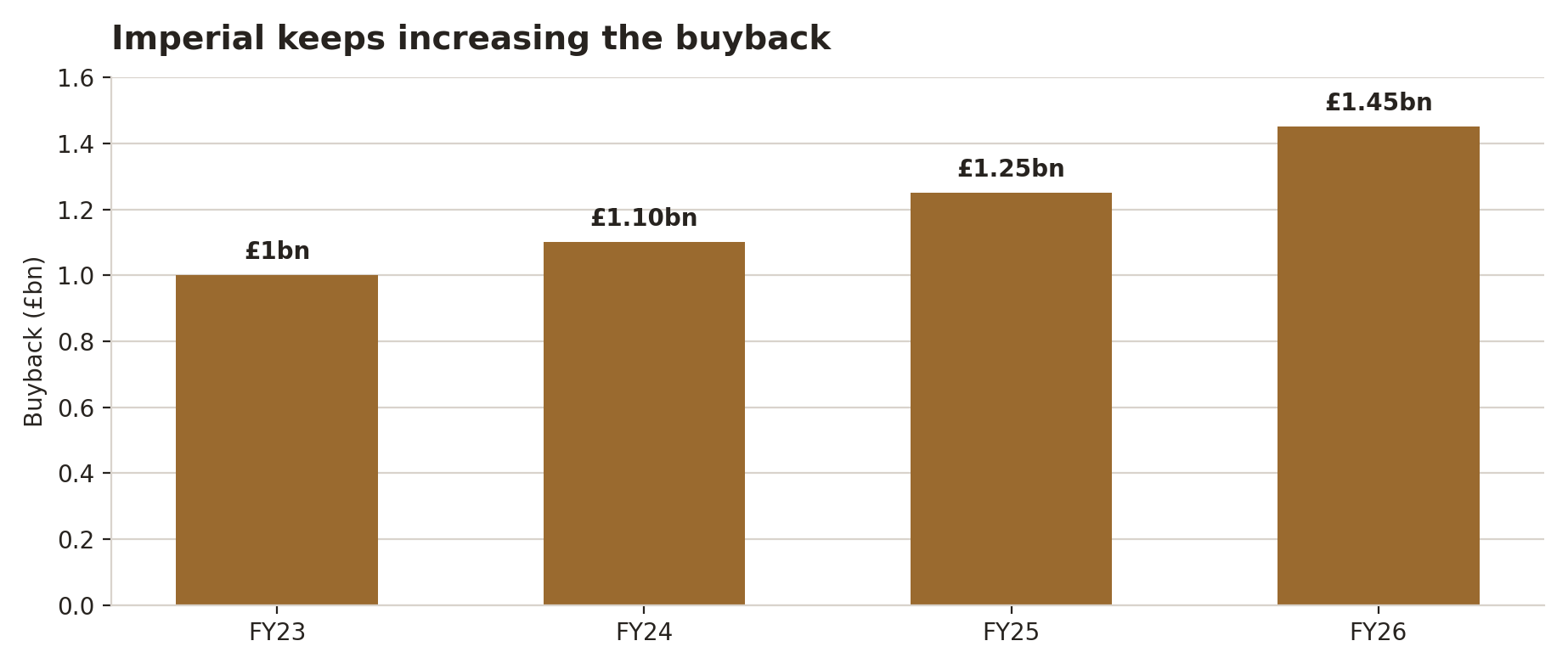
The buyback has increased every year since the programme began. Source: Imperial Brands company results.
How long until I own the whole thing?
This is the calculation that made me want to write the piece in the first place.
Take 762.8 million shares outstanding, a share price of £24.43, and free cash flow of £2.7bn. Now make the assumptions deliberately boring. Assume free cash flow never grows. Assume the dividend per share rises by just 2% a year. Assume everything left after the dividend goes into buybacks. And assume the share price never rerates.
There is no multiple expansion in that model. No rescue from a heroic NGP success story. No assumption that management suddenly discovers a second growth engine. It is a very plain setup.
Even then, the arithmetic gets silly quite quickly. The falling share count makes the dividend bill lighter. The lighter dividend bill leaves more room for the buyback. The buyback retires a bigger percentage of the remaining company. At a constant 2,443p, the toy model runs out of shares during FY2035.
Except mine.
I am obviously not claiming that I will literally become the last shareholder of Imperial Brands. The point is to make the mechanism visceral. At today’s price, this setup cannot just continue indefinitely without forcing some other variable to move. Either the shares rerate, the buyback changes, the cash flow deteriorates, or management allocates capital elsewhere. But the current combination of cash, valuation and buybacks has a very short fuse.
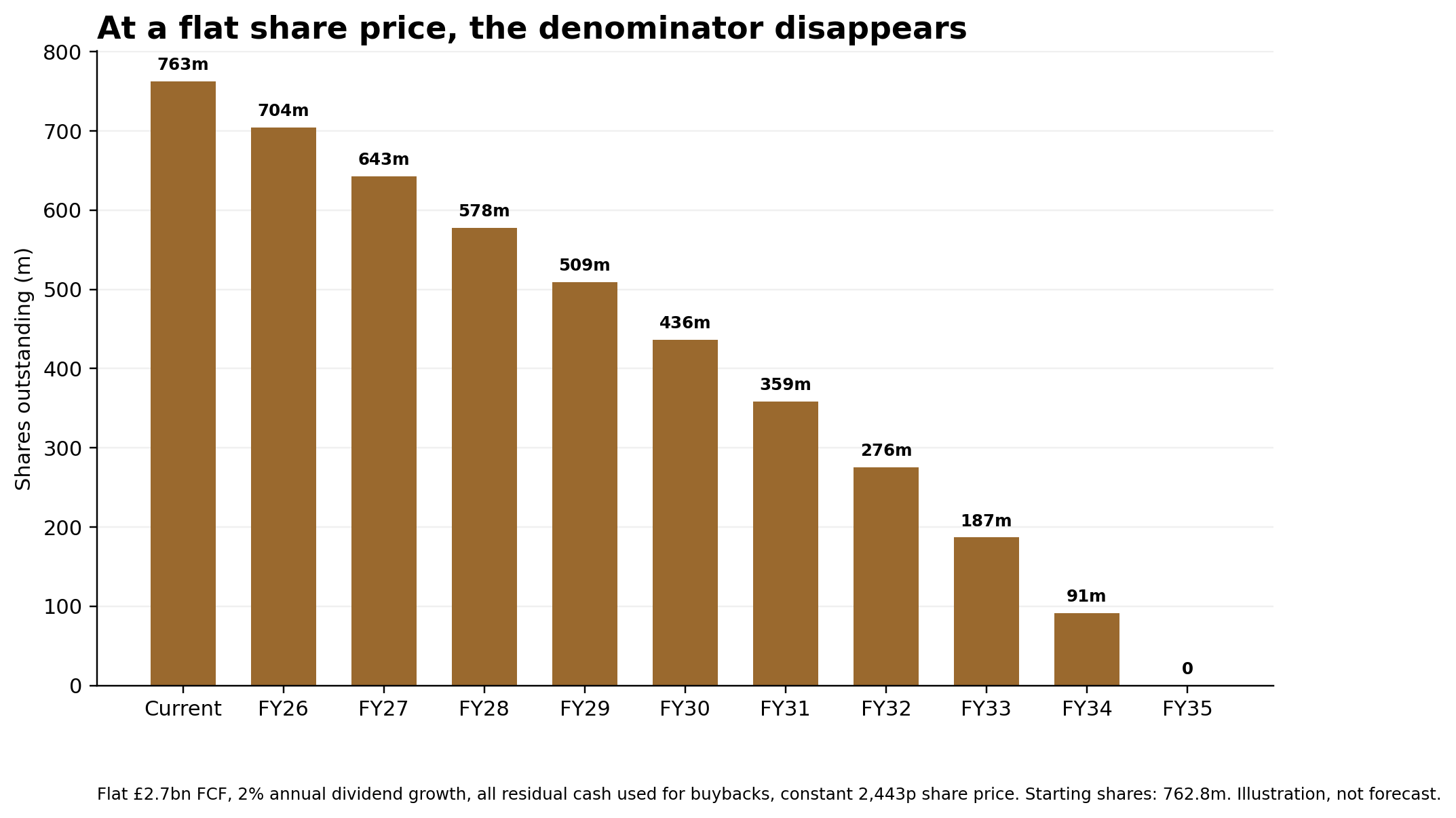
Flat £2.7bn FCF, 2% annual dividend growth, all residual cash used for buybacks, and a constant 2,443p share price. Starting share count: 762.8m, the latest disclosed figure excluding treasury after the 8 September 2026 repurchase. The model runs out of shares during FY2035. Illustration, not forecast. Source: Author calculation.
Why I do not mind a weak share price
This is the part of the thesis that still feels counterintuitive, even after you understand it. I own the shares, so instinctively I want the price to go up. But Imperial is also buying every day on my behalf.
At around 3,300p, a £1.45bn buyback retires roughly 44 million shares. At 2,443p, the same £1.45bn retires roughly 59 million. Nothing has to improve in the operations for the buyback to become meaningfully more effective. The market is simply offering the company more of itself for the same money.
That is why I am not praying for a quick rerating. A cheap price is not the enemy of this thesis. For a while, it is the fuel.
More importantly, I no longer have to infer whether management thinks about the share price the same way. At the Barclays Global Consumer Staples Conference on 9 September, Paravicini said the lower price makes the buyback more impactful because Imperial gets more shares back for the same money. He noted that roughly 20% of the share count had already been retired since 2021 and expects this year’s programme to remove roughly another 6%. He also reiterated the evergreen buyback and strongly signalled another significant programme next year, while making clear that the Board still sets the amount annually.
Is Imperial actually leaning into the sell-off?
One thing I wanted to check was whether the buyback was behaving the way a rational cannibal should. It is easy to say that a lower share price makes a repurchase more valuable. It is another thing to keep buying when your own stock is falling.
So far, the answer is encouraging. From April through July, Barclays spent about £5.5m per trading day on Imperial’s behalf, at a weighted average purchase price of roughly 2,780p, and bought about 196,000 shares per trading day. In August, as the shares fell into the 2,600s and then the 2,500s, average spend rose to £7.5m per trading day and shares bought rose to about 287,000 a day. The average purchase price was about 6% lower, while cash deployed per day was roughly 38% higher and shares bought per day about 46% higher.
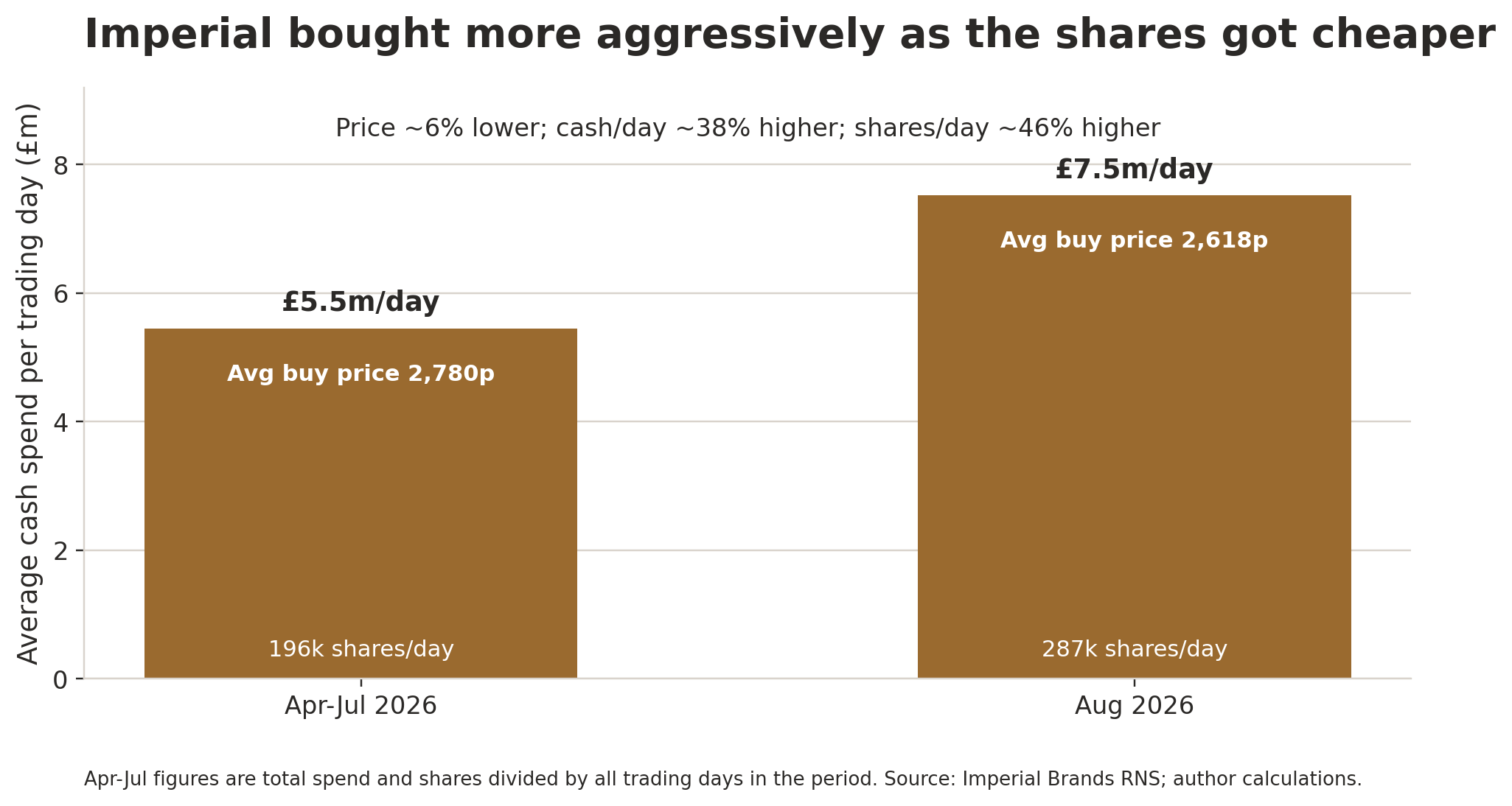
I would not overstate this. Barclays is executing the second tranche under an irrevocable, non-discretionary mandate, and daily purchases also depend on market volume and preset limits. There is another reason not to overread the next few weeks: only about £115m remains to be spent before the end of October, so the daily run-rate can fall materially from here without telling us anything about management’s view of the shares. Still, August is exactly what I want to see from a buyback programme when the stock gets cheaper.
There is an even cleaner way to see the benefit. The first £725m tranche bought 23.1m shares at an average 3,138p. The second tranche had already bought 22.4m shares by 8 September with roughly £115m still to spend. If that remaining cash were deployed around 2,443p, the same £725m would retire about 27.1m shares, roughly 17% more stock for exactly the same money.
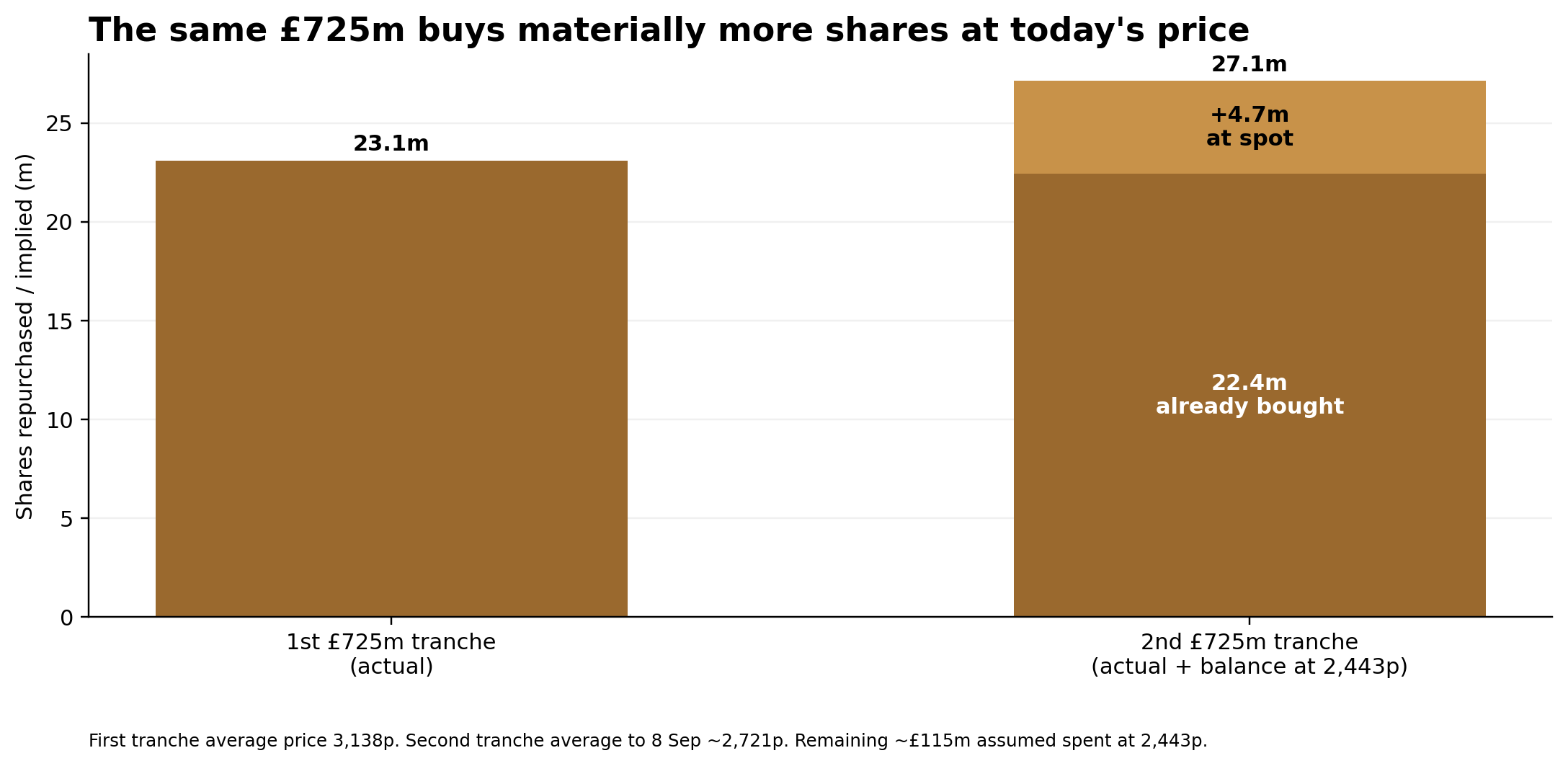
Source: Imperial Brands RNS announcements; author’s calculations. April-July daily averages use total spend and total shares bought divided by all trading days in the period. Second-tranche figures are updated through the 8 September purchase. Remaining cash is assumed spent at 2,443p for illustration.
This is why I care much more about the price at which Imperial buys its shares than whether the share price makes me feel good today.
Is the business good enough to feed the machine?
This is the only question that really matters. Buybacks do not save a bad business. If the underlying cash engine is collapsing, all you are doing is concentrating yourself into a worse asset.
So far, Imperial still looks good enough. In FY25, Tobacco and NGP net revenue grew 4.1% at constant currency. Tobacco price/mix was up 5.4%, more than offsetting the volume decline. More importantly, the volume decline has actually been improving for three straight years: -7.1% in FY23, -4.0% in FY24 and -1.7% in FY25. Free cash flow was £2.7bn and cash conversion was about 97%.
That is all I need. I do not need a miracle. I need a business that remains cash-generative and reasonably stable while management keeps shrinking the share count at sensible prices.
Why the market is sulking in 2026
The first half of FY26 was weak, and I do not want to hand-wave that away. Tobacco and NGP net revenue grew only 1.8% at constant currency and adjusted operating profit only 0.6%. Australia has been messy because illicit tobacco is damaging the legal market. The US has been tougher at the value end. NGP is moving in the right direction, but not in a clean straight line. There is also the Delaware litigation bill and a less friendly currency backdrop.
All of that explains why the market is unimpressed. What it does not prove is that the capital-return story is broken. In the same September discussion, with the financial year almost finished, Paravicini said Imperial remains fully in line with FY26 guidance. He pointed to the Australian step-down beginning to lap, a more stable tariff backdrop and the usual second-half flow-through of pricing as reasons for confidence in the H2 acceleration. The standing guidance remains 3% to 5% adjusted operating profit growth at constant currency, at least high-single-digit adjusted EPS growth and at least £2.2bn of free cash flow. If that holds, the machine still has plenty to eat.
I had originally planned to wait for an October pre-close before publishing this. I no longer think that makes sense. Management has just addressed the central questions in public and, as I write this, Imperial’s financial calendar does not yet list an October trading statement; the next scheduled results announcement is 17 November. Imperial has historically issued an early-October pre-close, so one may still be added. But I am not going to sit on the thesis waiting for a date that is not set and may only be a short update anyway.
One of the scarier summer risks has also eased. The original German excise proposal contemplated a roughly €2 increase and an accelerated September implementation. Paravicini said the September increase is now off the table and the discussion for January is around €0.50 to €1.00. A €1 increase could still hurt volumes, but this is a much more manageable setup than the one investors were worrying about a few months ago.
The self-help story is getting more tangible too. Management now expects the Langenhagen exit and Taiwan disposal to deliver around £100m of annualised savings once completed in July 2027, with manufacturing excellence adding another roughly £25m on an annual basis by the end of this year. I am not putting those savings into the toy model. I like that they make the flat-FCF assumption harder, not easier, to disappoint.
NGP is helpful, but it is not why I own the stock
I do not need Imperial to win the global race in next-generation nicotine. In my head, that business is still optionality, not the thesis. Later in the conversation, Paravicini described a deliberately disciplined approach: wait until a category is established, enter where Imperial has a route to market, and do not waste shareholder money trying to create a market from scratch. European vape is already profitable. The recent Helwit acquisition cost an initial £39.8m and more than doubles Imperial’s existing modern-oral share in Sweden, while Black Buffalo gives it another targeted route into US oral nicotine. Great if those assets compound. I do not need them to rescue the valuation.
There is also a US duty-drawback opportunity that should begin to contribute meaningfully in the second half of FY27 and have a full-year effect in FY28. Management did not quantify it, so I assign it no value here. That is the kind of upside I prefer: visible, potentially useful, and absent from my base case.
What could go wrong
The bear case is not mysterious. The flywheel stops working if free cash flow starts shrinking faster than the share count. That could happen if pricing power weakens, if excise or regulation bites much harder than expected, if the Australian problem spreads, or if Imperial has to give up too much margin to defend its US position. It could also happen if management keeps buying back stock but the stock turns out not to be cheap.
Those are the risks I care about. Not the share price falling. The cash flow falling.
What I still want to see
The thesis does not need another trading statement to exist, but three things still matter.
The FY27 buyback amount. Management has now strongly signalled another significant programme. It has not promised £1.45bn again, let alone a progressive increase. At today’s valuation, that number still matters enormously.
The full-year cash numbers. I want FY26 free cash flow, leverage and cash conversion to confirm that the operating business is still feeding the machine.
The operating detail. I want the US and Germany share dynamics to look controlled, Australia to stop getting worse, and NGP to keep moving toward profitability without swallowing capital.
The verdict
This is why I like the story. I do not need Imperial to become a different company for this to work. I do not need it to out-innovate Philip Morris, and I do not need some heroic terminal value. I need a business that keeps generating decent cash, a management team that keeps returning it intelligently, and a share price low enough that those repurchases create real value for the people who stay.
At 2,443p, Imperial is not far from that sweet spot. On the forward annualised dividend run-rate, the yield is about 6.8%. The buyback is roughly 7.8% of the current market value on its own. The dividend pays me while I wait. The buyback increases my ownership while I wait. And, slightly perversely, the market’s boredom helps rather than hurts me.
The September conference gave me enough to stop waiting. Management says the cash guidance still holds and the buyback remains an important lever. What I want now is the FY27 number.
I own the shares. My share count is not going down.
Disclosure
I own shares in Imperial Brands. This article reflects my personal research and opinions and is not investment advice. The projection above is a thought experiment designed to illustrate the mechanics of a shrinking share count; it is not a forecast.
Source note: Operating figures and capital-return figures are drawn from Imperial Brands annual reports, FY25 results and HY26 results. September management comments are paraphrased from CEO Lukas Paravicini’s 9 September 2026 Barclays Global Consumer Staples Conference webcast on Imperial Brands’ investor-relations site. Daily buyback figures, current share count and programme progress are drawn from Imperial Brands RNS announcements; buyback charts are the author’s calculations. Market price used: 2,443p, the 9 September 2026 close. Shares in issue excluding treasury shares: 762.8m after the 8 September purchase. Second-tranche spend through that purchase: approximately £609.9m, leaving approximately £115.1m.