

01 · The paradox
Brazil re-rated. Its digital banks didn’t.
Nubank (NYSE: NU) earned $1.06bn in the second quarter. That’s the first billion-dollar quarter in its history, up 67% in reported dollars (49% at constant exchange rates), on a 33% return on equity. The shares went the other way.
Blaming Brazil doesn’t survive a dollar comparison. By 23 October, two days before the runoff, the iShares Brazil ETF was up 34% for the year and Itaú’s New York shares 35%. Nubank was down 9% and Inter&Co, the other listed digital bank, 15%. Then Lula won a fourth term, and on 26 October the Brazil ETF lost 20% in a day, Itaú 20%, Nubank 17% and Inter 35%.
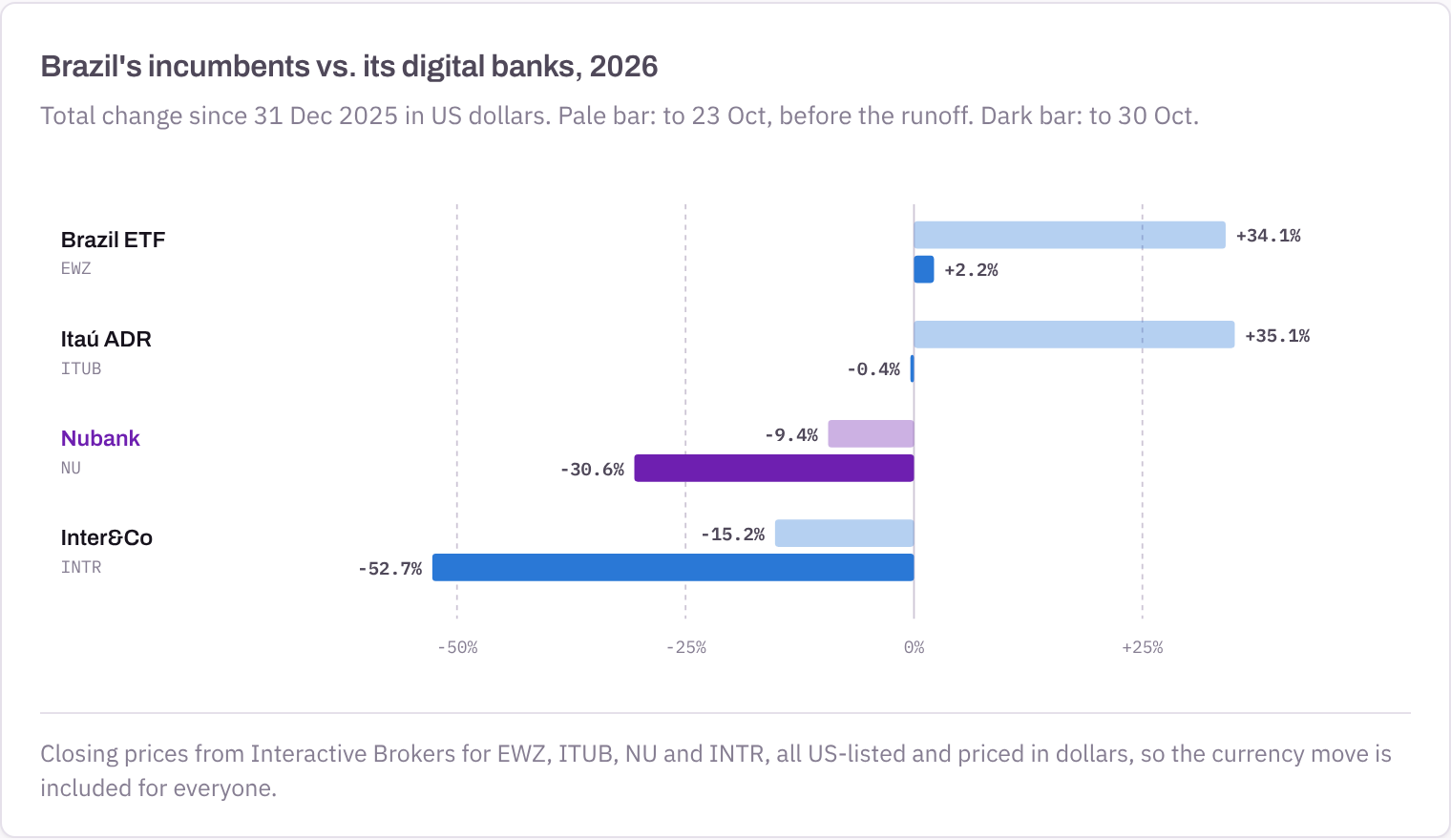
So before a single vote was counted, investors were paying up for Brazil’s old banks and marking down its digital ones, so Nubank’s problem wasn’t only Nubank’s. It has held up far better than Inter, though, which tells me the market still separates the two. The doubts are about Brazilian digital lenders as a group, and Nubank is the biggest of them.
What actually happened: the multiple, not the earnings
Earnings went up. The price went down. That leaves one culprit: the multiple.
At January’s peak Nubank traded at 36 times trailing earnings; today it’s 15.5. Earnings per share rose more than 40% over that stretch while the multiple more than halved, and the real question is why investors decided to cut it.
The roots go back to December 2021, when Nubank listed at a valuation that had already banked most of this decade’s growth. Since then it has gone from loss-making to more than $4bn of annualised profit, and the shares from the $9 IPO price to $11.61. Five years of superb execution have been spent paying down the IPO multiple.
My question: does being someone’s main bank make Nubank a better lender? Seeing the salary arrive and the bills go out should help. How much protection that buys when borrowers start struggling is the part nobody can see yet.
02 · The business model
A lender in disguise
Everyone quotes the dollar a month it costs Nubank to serve a customer. It’s true, and it’s the smallest line in the stack. What you’re buying is a credit business with a very cheap shop window bolted to the front.
Where revenue comes from
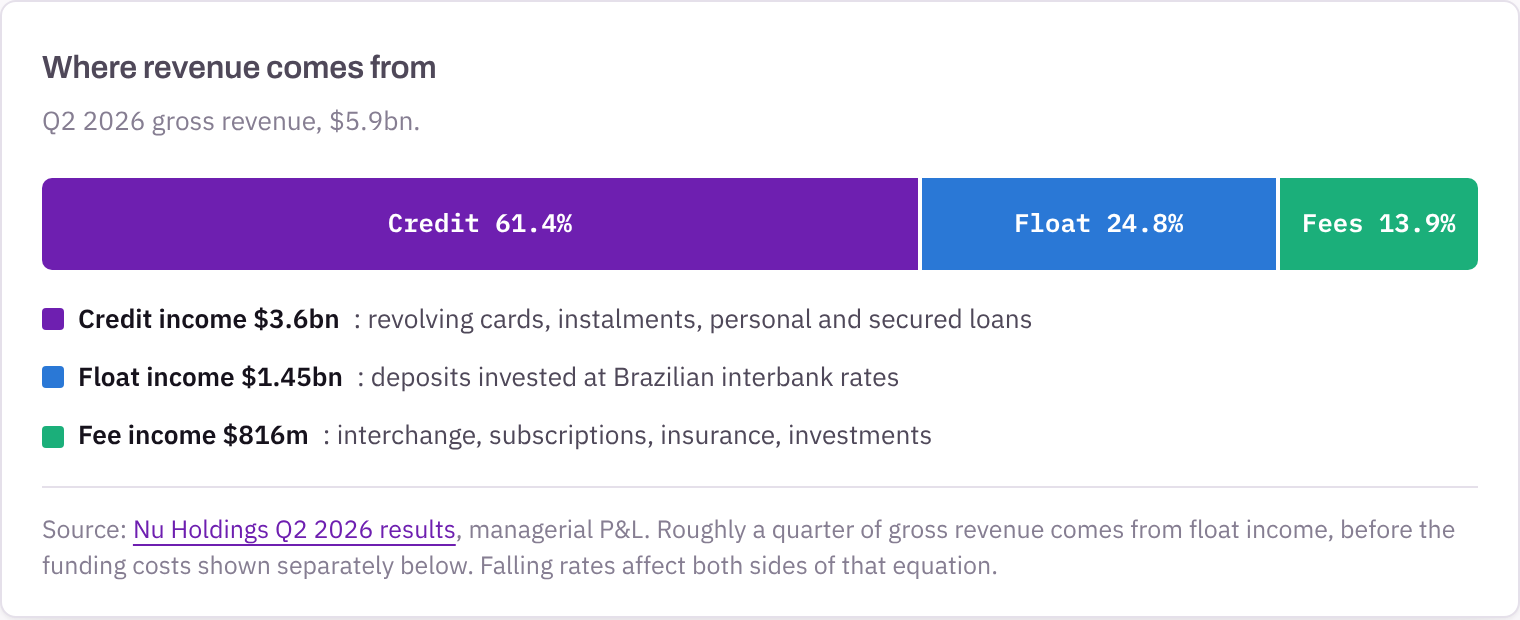
Roughly a quarter of gross revenue comes from float income, before the funding costs shown below. Falling rates affect both sides of that equation.
One customer, one month
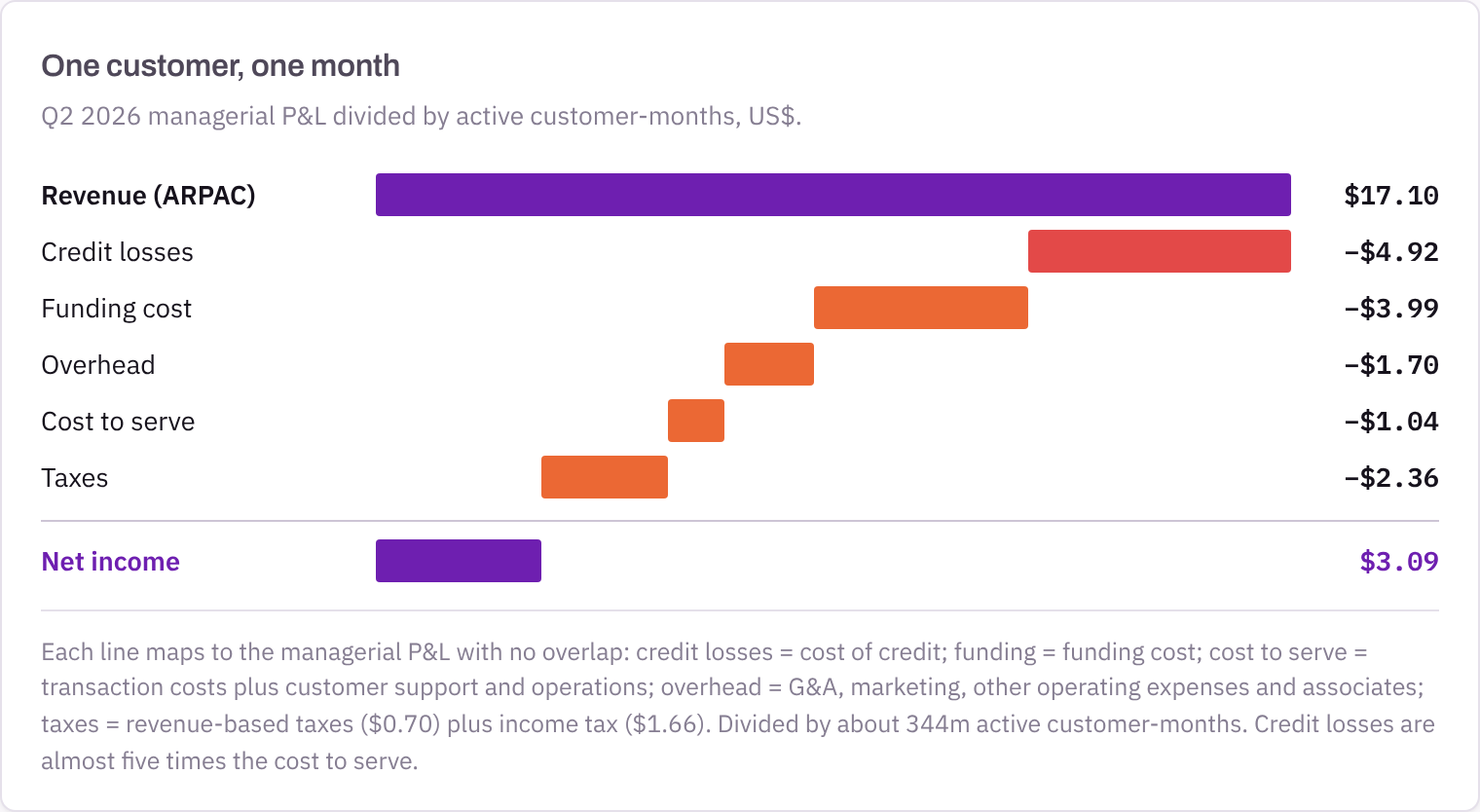
Each line maps to the managerial P&L with no overlap: credit losses = cost of credit; funding = funding cost; cost to serve = transaction costs plus customer support and operations; overhead = G&A, marketing, other operating expenses and associates; taxes = revenue-based taxes ($0.70) plus income tax ($1.66). Divided by about 344m active customer-months. Credit losses are almost five times the cost to serve.
The 60% / 7% opportunity
Nubank counts more than 60% of Brazilian adults as customers yet, by its own estimate, captures only about 7% of the profit pool it goes after, and that gap is the opportunity. The customers are already in the app, so Nubank doesn’t have to find them, only sell them more. Every salary moved across, every payroll loan, every upgrade to Ultravioleta or Croma lifts its share of a pool it can already reach. The catch: the incumbents kept the wealthier Brazilians, where most of the profit sits, and Nubank hasn’t yet won their main account.
03 · Comparables
A Category of One
Dozens of companies have built a bank inside an app. Almost none of them have become the bank people actually live in.
Put Nubank next to Revolut and the difference jumps out. Revolut had a superb 2025: 68.3m customers, $6.0bn of revenue and $1.7bn of net profit, up from about $1bn. Nubank ended the year with 131m customers, $16.3bn of revenue and $2.87bn of net profit. Both run without branches, serve customers for pennies and grow fast. Lending is where they part company. Revolut’s whole loan book was $2.9bn at the end of 2025, or $42 per customer. Nubank’s was $39.4bn in June, $283 per customer.
Some of that gap is choice. Revolut was built around payments, travel and trading, and came to lending late. The rest is information: a bank lends with confidence to people whose finances it can see, and it sees them best when the salary lands in the account. For many Revolut customers it’s still a second account. For tens of millions of Brazilians Nubank is the first, so it sees the rent, the salary, the phone bill and the day they run short before payday.
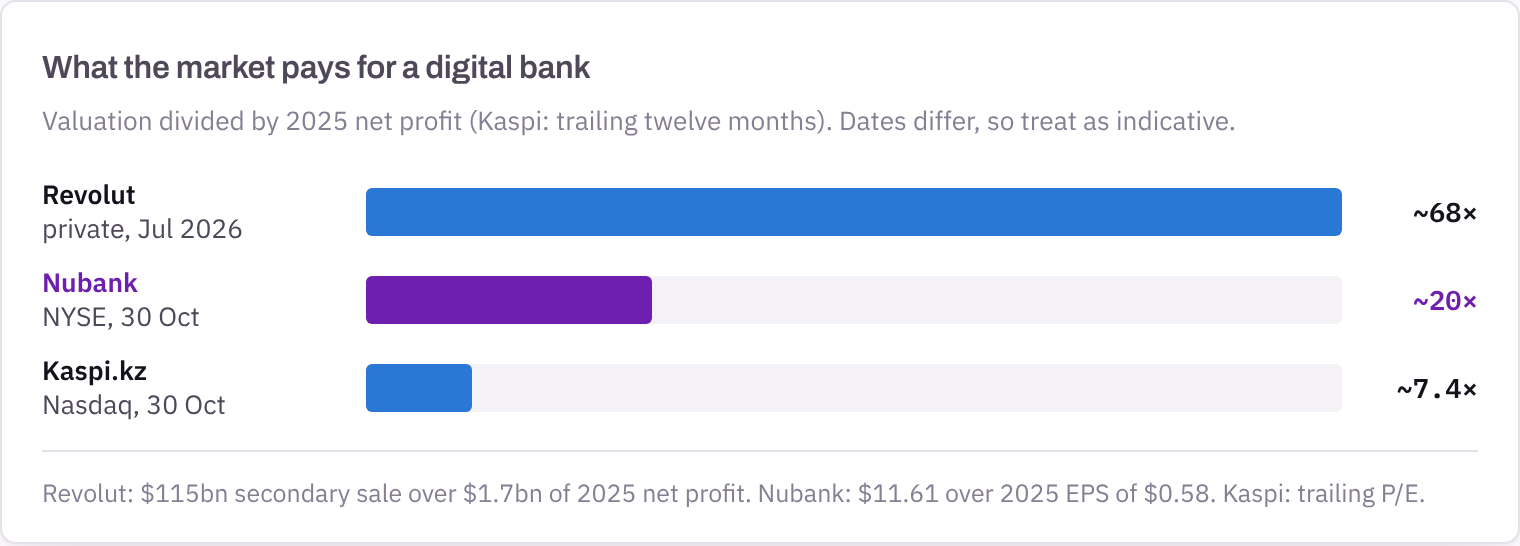
And yet the market pays the other way round. In July Revolut’s shareholders sold stock privately at $115bn, 68 times 2025 profit. Nubank is worth around $56bn on the exchange, 20 times. Part of that premium is private-market froth (secondary sales are thin, and I wouldn’t take Revolut’s number too literally). Part of it is a fee-heavy model that doesn’t rely on unsecured credit. Still, the public market values the company that won primacy at less than half the one that hasn’t.
The primacy gap
In Brazil, 24.4% of consumers name Nubank as their main bank, up from 21.7% a year earlier, in Okiar’s annual survey of more than 2,000 people. No institution scores higher, and Itaú, the largest private bank, gets half that.
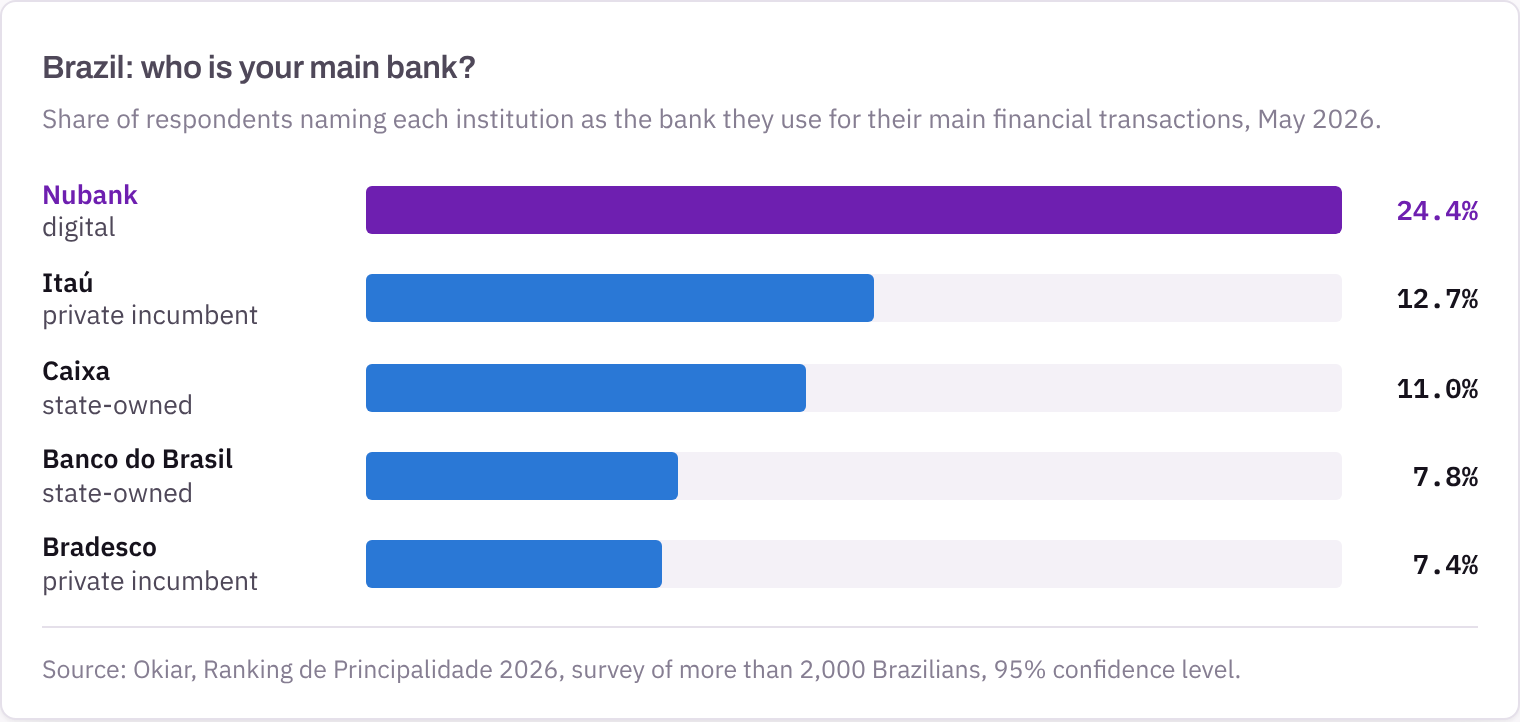
France tells a different story, though its survey asks something else. OpinionWay, for MoneyVox, measured what share of each bank’s own customers have most of their income paid in. For Revolut it was 15%, for BoursoBank 42%, and only 6% of Revolut’s French customers use it as their only bank. Only the direction is comparable with Brazil, and in France the neobank is still the second account.
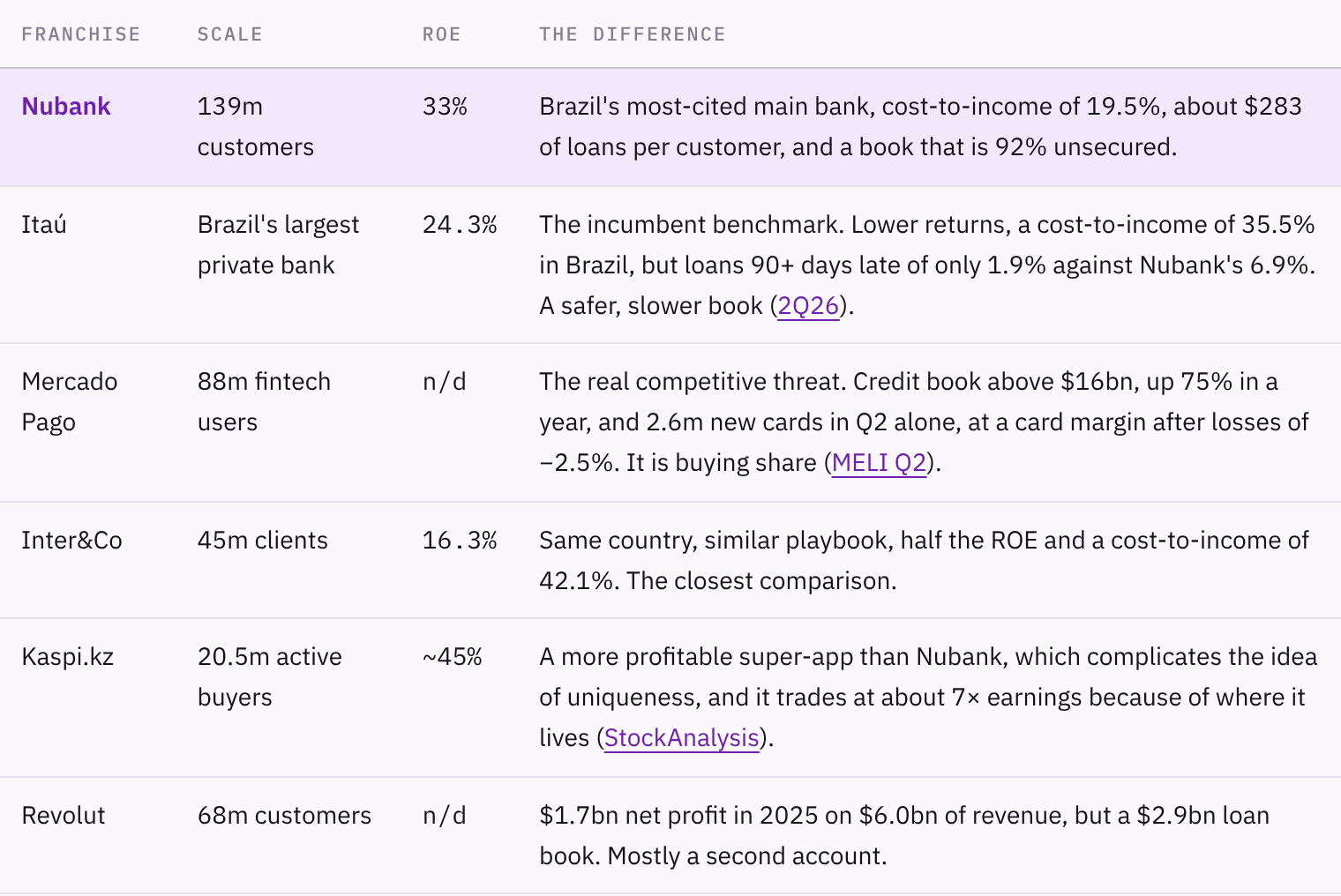
Most fintechs sit next to a traditional bank as a handy second account. For tens of millions of Brazilians, Nubank has replaced the traditional bank outright, and Forbes’ customer survey has ranked it Brazil’s best bank eight years running. That puts it in a category of one. Two caveats: Kaspi shows a super-app can be even more profitable, and Brazil (high-fee incumbents, then Pix) made switching unusually easy.
04 · The growth engine
The $28 customer
In my base case customers grow 39% to 2030 and revenue per active customer 63%, so what each relationship is worth does more of the work than the headcount.
From 54 million to 182 million
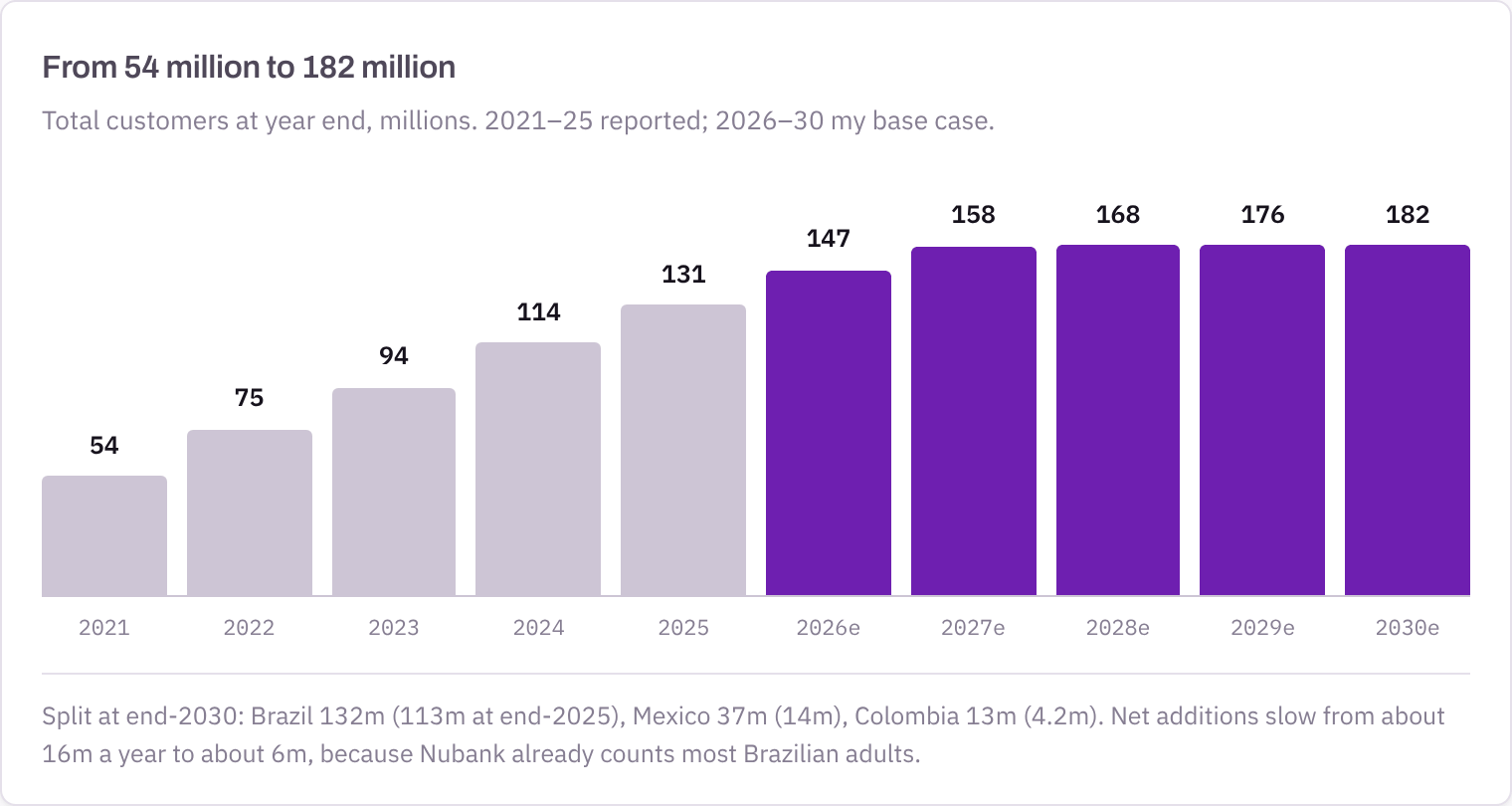
Split at end-2030: Brazil 132m (113m at end-2025), Mexico 37m (14m), Colombia 13m (4.2m). Net additions slow from about 16m a year to about 6m, because Nubank already counts most Brazilian adults.
The ladder, and why I don’t fully trust it
Every quarter Nubank publishes how much revenue a customer brings in each month, by how long they’ve been with the bank. I’ve redrawn it from the company’s figures.
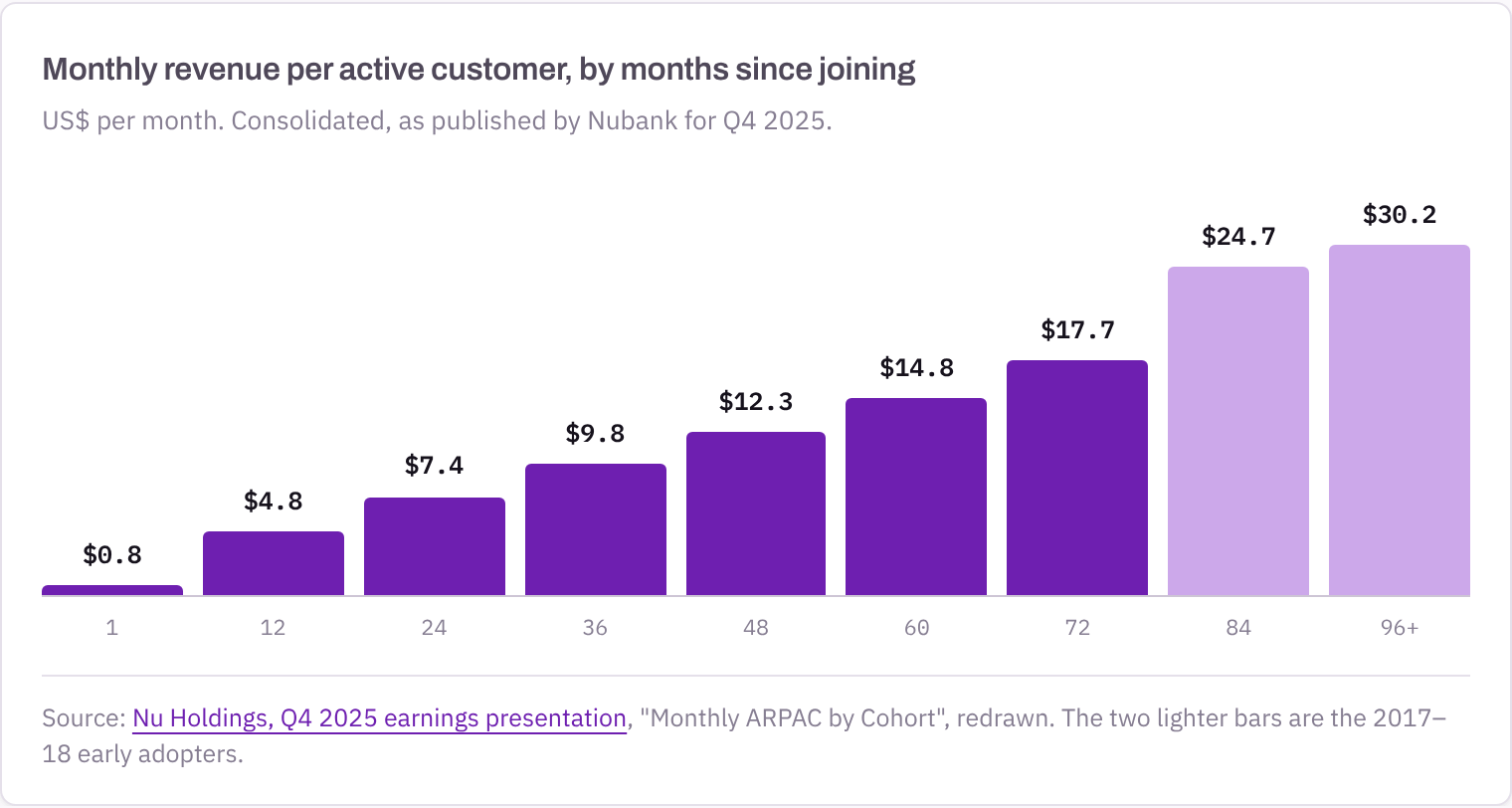
It’s tempting to read it as a life story: join at 80 cents, grow into a $30 relationship. But the chart is a snapshot of different groups at one moment, not a film of the same customers over time, and it’s the assumption in my model I trust least. The eight-year customers joined when Nubank was invitation-only and courted urban, connected, better-off Brazilians. Someone who joined in 2022 from the interior may never look like them. And the curve already contains a decade of cross-selling and credit expansion, so I can’t add those again.
So I aged each yearly group along the ladder with two guardrails. Customers who joined after 2018 climb at the slower pace seen between years five and six. And the base case caps the tenure curve at $30.20 (today’s best observed level) before a separate annual monetisation adjustment, so ageing alone can’t push a cohort past it. The same consolidated curve runs every country, Mexico included. On top sit three paths for how the ladder itself moves, which also soak up currency and country mix.
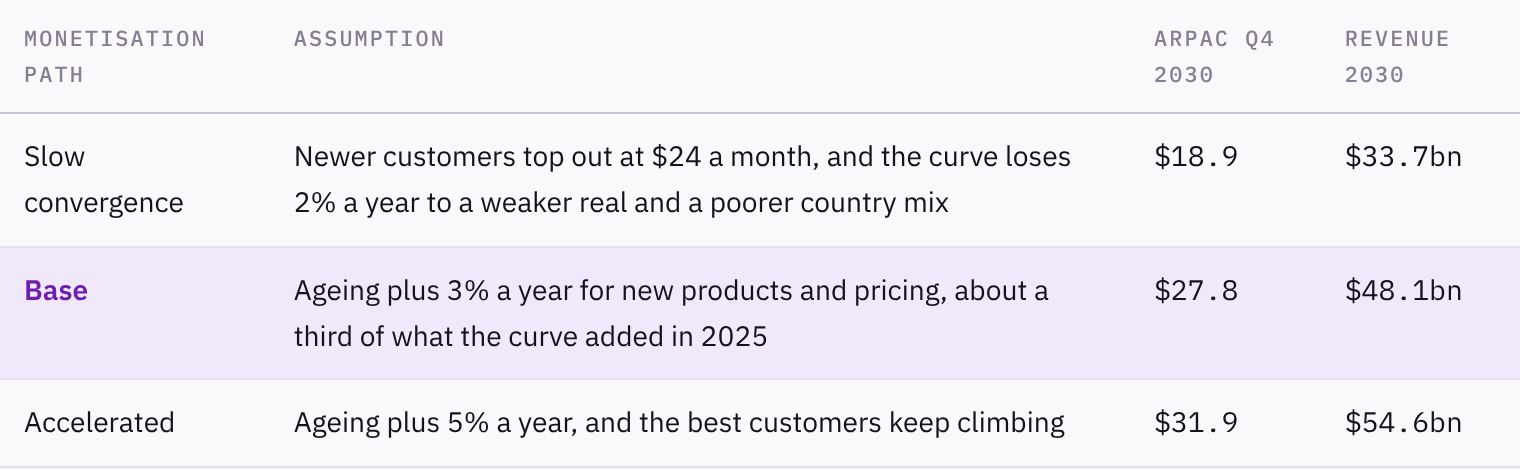
Revenue was $16.3bn in 2025 with monthly ARPAC of $17.10 in Q2 2026. All paths assume 83.5% of customers active in a month, as today. Back-tested against Q1 and Q2 2026, the base path sits 2–5% below reported ARPAC.
The slow path is the one to keep in mind: if newer customers never get as valuable as the early ones, revenue per customer barely moves and 2030 revenue comes in a third below my base case, with no recession needed. And more revenue isn’t automatically better: it only counts if the extra credit losses and capital leave more profit behind.
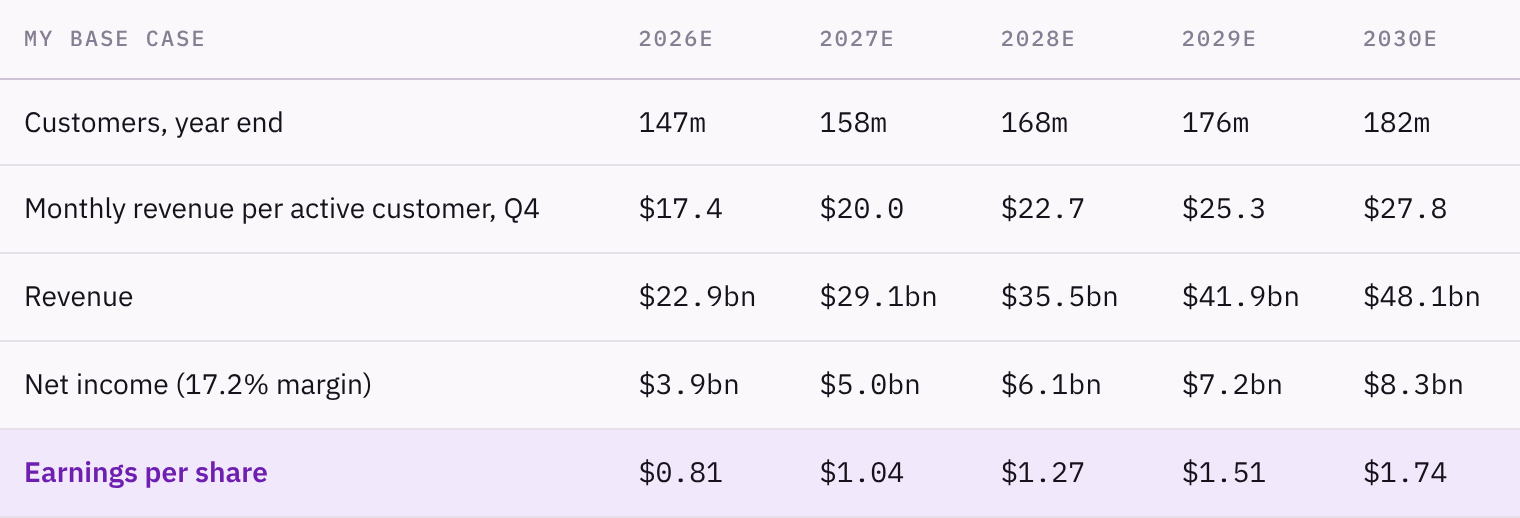
For 2026 and 2027 my EPS sits slightly below analyst consensus ($0.86 and $1.11). Net margin 17.2% against 18.1% in Q2 2026, because falling rates should squeeze deposit income. Shares fall gently with buybacks, from 4.85bn to 4.75bn. The margin is the most fragile input, and I stress it in section 06.
Potential upside beyond the base case
Cross-selling and the past decade’s credit growth are already in the curve. New products, pricing and buybacks are already in the model (the 3% lift and the falling share count). Three things could push past the base case. I haven’t modelled them separately, and some of their benefit may already sit inside my assumptions:
Mexico, faster. Mexican customers monetise earlier than Brazilians did: $12.30 a month against $5.60 at the same stage. Nubank broke even there in Q1’26 and became a full bank in August. My model runs Mexico on the consolidated, mostly Brazilian curve, so it may understate the 37m customers I project there for 2030.
Going upmarket. Ultravioleta for high earners and Croma, launched in July 2026, for the tier below. If Nubank wins wealthier clients, it moves into the 93% of the profit pool it doesn’t yet have, which the historical curve reflects only partly.
Payroll and secured lending. Loans repaid straight from the salary, including Brazil’s new private-sector payroll loans. Lower yields than cards, but far lower losses, so the benefit should show up in a safer margin.
The rest is smaller or further off. Small businesses (6.8m of them), insurance, investments and AI-driven cost cuts help at the edges. The US, launched in September, is a bounded option: management caps the spend at about one point of the efficiency ratio, the cost is real today, and I put no US revenue in the numbers.
05 · The bear case
What if the market is right?
The bulls have been right about the business and wrong about the stock, because their framework assumes the multiple is the market’s mistake rather than its judgement.
My main worry is that I’m projecting unusually good lending returns too far forward. If I am, I’m overstating revenue, margin and the multiple.
1. Is the cohort curve really predictive? (revenue)
As I said, the ladder compares different customers rather than following the same ones. If newer customers stay poorer and less engaged than the early ones, the slow path applies: revenue per customer barely grows and 2030 revenue lands near $34bn instead of $48bn.
2. Are credit losses being pulled forward, or is the book deteriorating? (margin)
Of a $39.4bn credit portfolio, $36.3bn is cards and unsecured loans. No single ratio settles it, so I read several together:
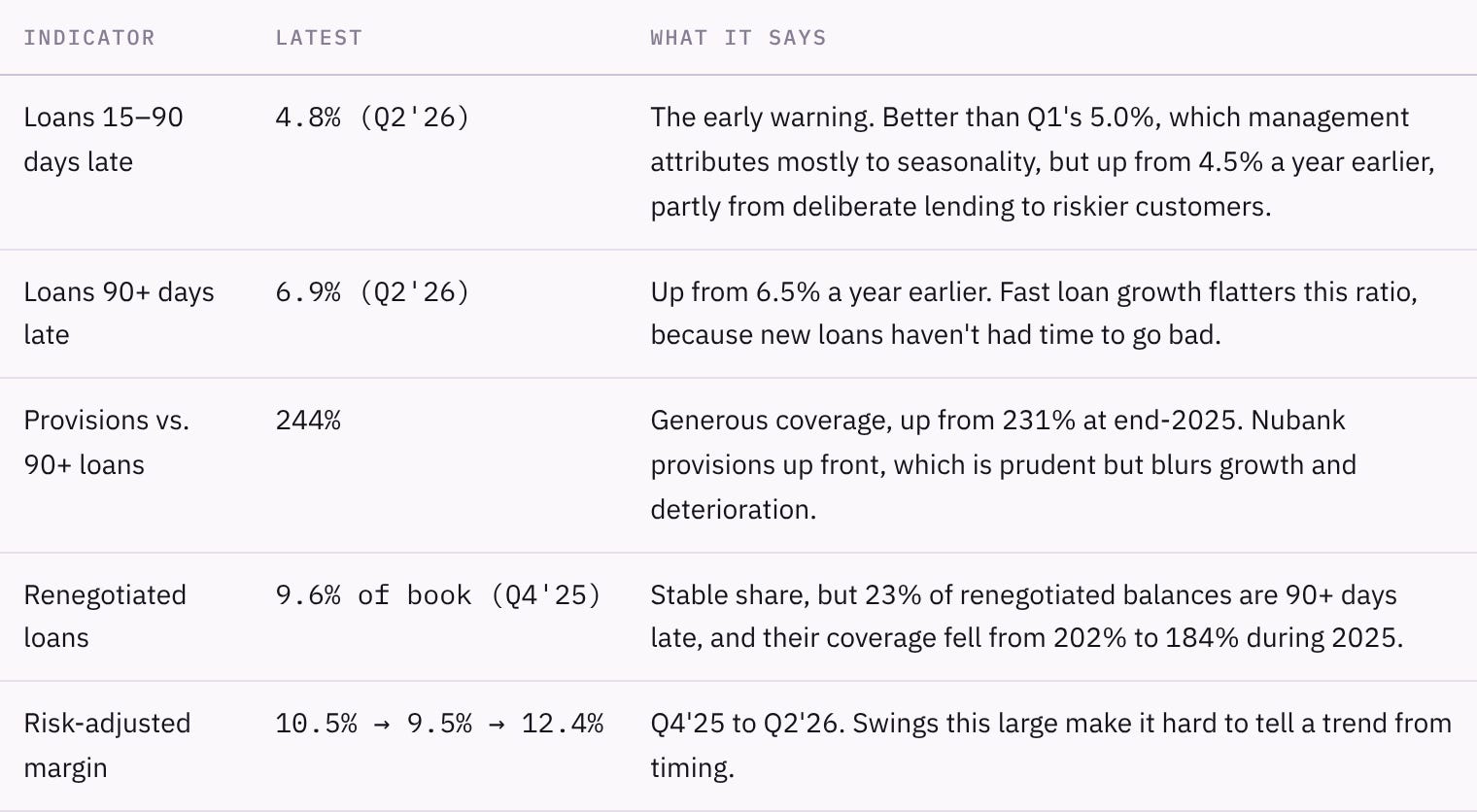
One piece of evidence links primacy to credit. Management says customers who use Nubank as their main bank default at roughly half the portfolio average (Q2 2026 results). It’s company-reported, and better-off customers may simply be the ones who pick Nubank as their main bank, so it isn’t proof. It’s still the mechanism the bull case relies on, and the figure I’d most like Nubank to disclose in more detail.
My reading: nothing here shows a book in trouble, and nothing proves it isn’t. This book has never been through a proper Brazilian recession at its current size, and until recent lending seasons through one, nobody knows how much of today’s margin is structural. Every point of net margin is worth about $480m of 2030 profit, and two good quarters would help without settling anything.
I’ve watched banks go through a real crisis from close up. I spent the financial crisis on a trading floor at a large investment bank, and part of my pay came in bank shares, so I followed the sector’s balance sheets with my own money in them. What stayed with me is that the banks that went in earning high returns came out stronger. A fat return on equity is first a cushion, the profit that soaks up bad loans before they reach capital, and only then a reason to pay up. That’s the part of Nubank’s 33% I value most.
3. Is the multiple discount justified? (multiple)
Nubank is a bank, so I check it like one. Book value is $2.74 a share, and the stock trades at 4.2 times book. A simple steady-state formula, price-to-book = (ROE − growth) ÷ (cost of equity − growth), gets close to that multiple with a return on equity of about 33–34% held for ever, roughly 9% growth and a 15% dollar cost of equity. Drop returns to 25% and the same formula gives $7.30 a share on today’s book. On that view, 15.5 times trailing earnings for an unsecured Latin American lender exposed to the real isn’t irrational.
The other risks, briefly
Management turnover (high). President and COO Youssef Lahrech stepped back in May 2025. CFO Guilherme Lago handed over to Rob Livingston in June 2026. CTO Eric Young resigned in October. The shares peaked in January, before the last two departures, so I won’t claim turnover caused the de-rating. It does add uncertainty to a story priced on execution.
Rates and the real (high). Roughly a quarter of gross revenue is float income. Falling rates shrink it, but they also cut funding costs and take pressure off borrowers, so the net effect isn’t obvious. Lula’s win raises the fiscal risk premium and weakens the real, which makes the central bank warier on inflation and slows rate cuts. And a weaker real cuts dollar earnings mechanically.
Competition and regulation (medium). Mercado Pago’s card push (see the table above) is how consumer-credit price wars start. Brazilian card rates are a permanent political target, and the tax on Nubank’s main licence has already gone from 15% to 20%.
Costs and the US (medium). Cost-to-income rose from 17.6% in Q1 to 19.5% in Q2 2026 as office, AI and international spending grew. The US launch pays up to 4.5% on deposits with no cost advantage, in a market where Chime reportedly spent $635m on marketing to add 1.5m active users in a year.
06 · Valuation
The price of being wrong
Which multiple, though? At $11.61 Nubank trades at 20.0 times 2025 earnings, 15.5 times the last twelve months, 14.3 times my 2026 estimate and 9.1 times my 2028 estimate. Same price, four numbers, and the cheap one only holds if my forecasts do.
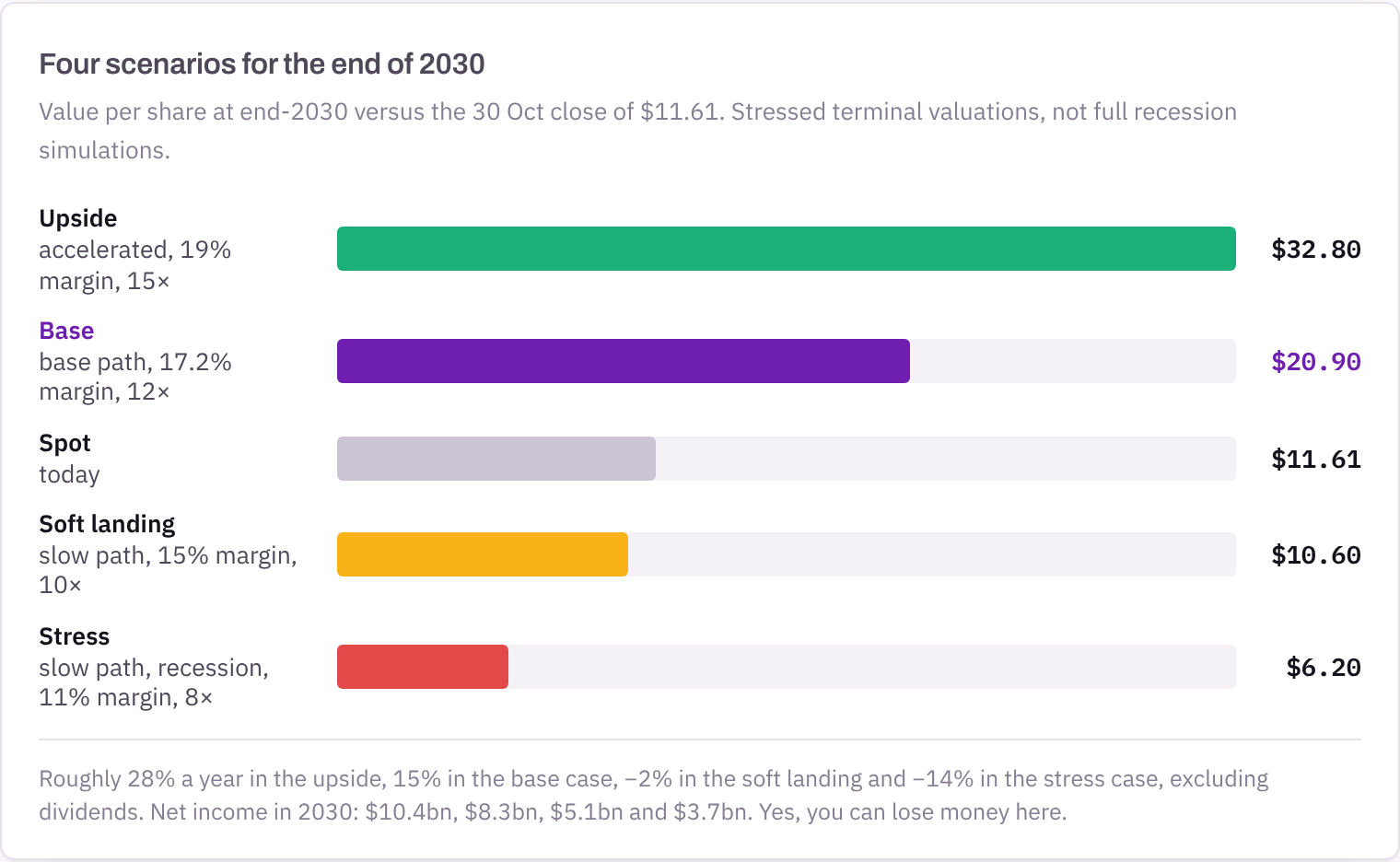
Roughly 28% a year in the upside, 15% in the base case, −2% in the soft landing and −14% in the stress case, excluding dividends. Net income in 2030: $10.4bn, $8.3bn, $5.1bn and $3.7bn. Yes, you can lose money here.
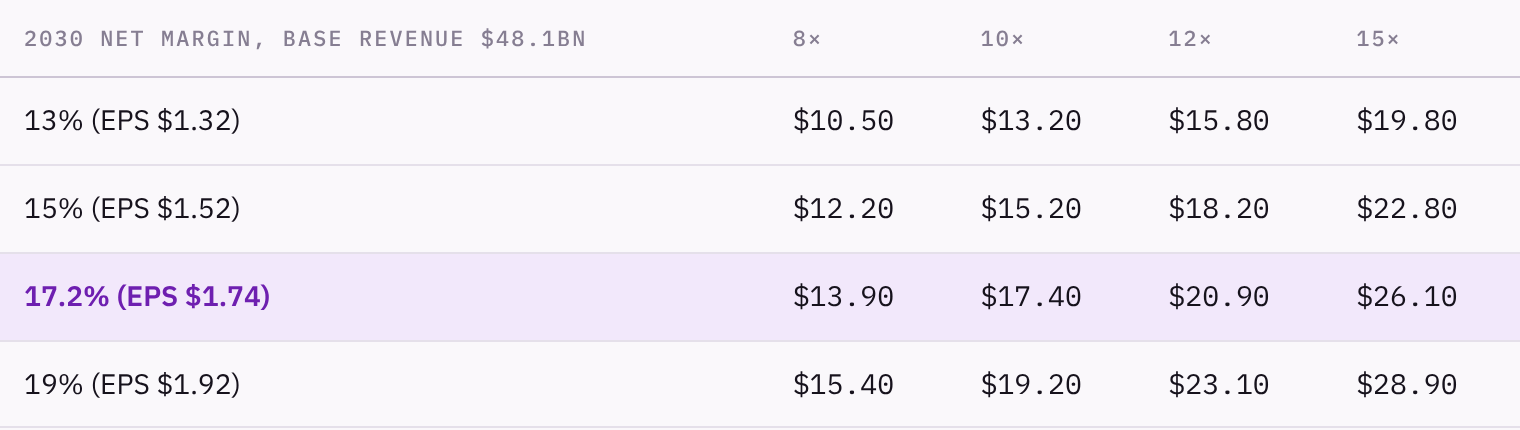
My base case gets to about $21 by the end of 2030. From $11.61 that’s roughly 15% a year, which is exactly the return I demand for this risk.
That base case uses 12 times 2030 earnings: below today’s trailing multiple, above the 9 times my 2028 estimate implies now. Margin and multiple both move the answer:
Capital: where the earnings go
A 33% return on equity is only worth that much if the profit gets reinvested at similar returns or handed back. At the end of 2025 Nubank’s regulated entities held about $2.2bn more capital than required, plus $3.0bn of cash at the holding company (Q4 2025 presentation). That $5.2bn buffer looks comfortable today, but fast loan growth eats regulatory capital quickly. In my base case equity reaches about $39bn by 2030, roughly $8.15 a share, so $20.90 is about 2.6 times book for a return on equity in the low-to-mid 20s. Bigger buybacks than I assume would lift earnings per share; dividends return capital without shrinking the share count. Either way that money stops earning inside the bank.
07 · My verdict
The election was the headline. The loan book is the story.
At $11.61 the hangover from the 2021 IPO valuation is largely worked off. I don’t need heroic assumptions about America or a return to 30 times earnings. My base case gets to about $21 a share by 2030 (roughly 15% a year), mostly from customers maturing along the curve and valued at 12 times earnings.
That 15% is my required return and no more, so it only works if the loan book holds. The whole bet is whether Nubank can push revenue per customer towards $28 without handing the gains back in bad debts. Higher revenue means little if it comes from shakier borrowers, so I’ll watch the risk-adjusted margin (around 12% today), early delinquencies, renegotiations, and whether Mexico stays in the black as it scales.
The market has already halved Nubank’s multiple. The election was the headline; the next credit cycle will tell us whether $11.61 was a bargain or a fair warning.
À bientôt, Guillaume
Sources: Nu Holdings Q2 2026 results and Q4 2025 presentation; Revolut 2025 results; Itaú 2Q26; MercadoLibre Q2 2026; Inter&Co Q2 2026 results; Kaspi.kz statistics; Okiar Ranking de Principalidade 2026; OpinionWay for MoneyVox (2025); Forbes World’s Best Banks 2026; Nubank US launch (Reuters, Fintech Brainfood). Share prices for NU, EWZ, ITUB and INTR from Interactive Brokers. Projections for 2026–30 are my own cohort model.
I own shares in Nu Holdings (NYSE: NU). This is my own research and opinion, not investment advice, and I’m not a licensed adviser.