

In Part 1, I said I own Basic-Fit because I like the economics of the clubs it already has, and that I’ve kept the position small because I’m less sure what happens to the cash those clubs throw off. This piece is about that cash.
A quick recap, in case you missed the first part. The market values Basic-Fit’s full gyms at roughly what it would cost to build them empty. Basic-Fit runs its clubs more cheaply than smaller rivals and uses that to open several clubs in the same town, and the density makes it harder for anyone else to make money there, which in turn protects the low costs. The McFit clubs it bought in Spain also suggest that a gym can earn a lot more once it carries the orange sign.
On my numbers, the network now generates about €200 million a year before any growth spending, and that figure should keep rising as younger clubs mature. Basic-Fit can open new clubs with it, buy competitors, pay down debt or buy back its own shares. In Part 1 I promised you a return on each of those, and the chart below is the result.
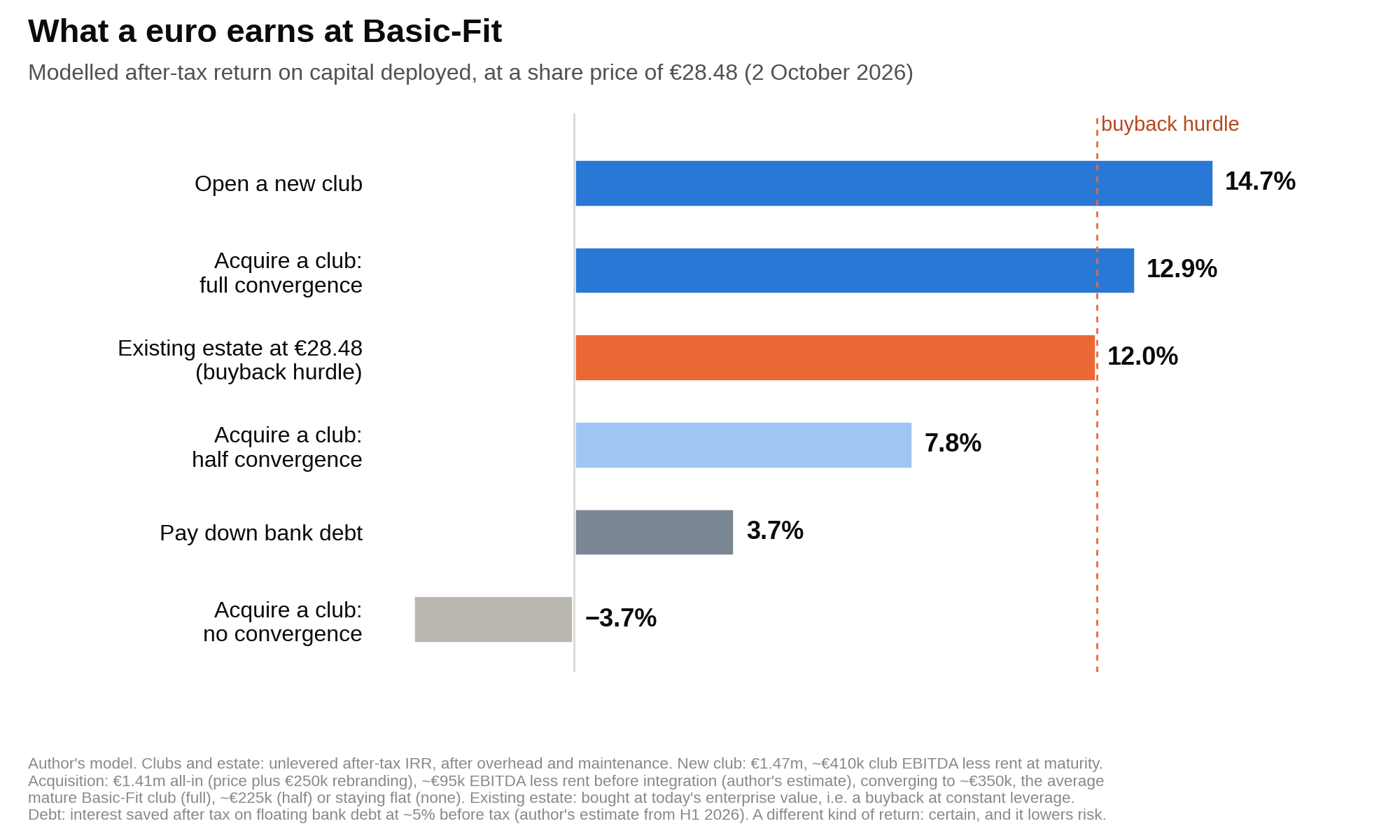
New clubs come out on top at about 15%. Buying more of the existing estate, which is what a buyback amounts to, implies about 12%, and paying down debt saves under 4% after tax. Acquisitions have by far the widest range: anything from about 13% down to a loss, depending on how far the clubs Basic-Fit buys end up earning what its own clubs earn.
How I compare them
Three of the four options buy operating assets: a new club, someone else’s club, or a bigger slice of Basic-Fit’s own estate. For those three I estimate the after-tax return on the money invested, after overhead and maintenance, over a long club life. A buyback fits that frame as long as debt stays at roughly the same level relative to earnings, because you’re then buying a slice of the whole business, clubs and borrowings together. It works much like a landlord buying out a co-owner: same buildings, same mortgage ratio, a bigger share of the rent. At €28.48 a share, Friday’s close, the implied return on the existing estate is about 12%. That is the hurdle every other use of cash has to clear.
Paying down debt earns a different kind of return. What you get is the interest you no longer pay, which is smaller but predictable, and it lowers risk at the same time. It’s on the chart, but I don’t pretend it is the same measure as the other three.
Management and I agree on the first call on cash, which is new clubs. After that we part ways. At the Capital Markets Day in April, Basic-Fit put acquisitions second, the balance sheet third and the “potential to return capital to shareholders” last, and its record fits that order. In December 2024 Impactive Capital, then the largest shareholder, publicly asked for €100 million of buybacks a year. One million shares were bought back for €26.2 million in 2025, then the programme stopped, and since then about €250 million has been committed to Clever Fit, wellyou, Speedfit and Kraftwerk.
New clubs
Basic-Fit says it only signs a lease for a new club if it expects a return on invested capital of at least 30% at maturity, measured at club level before overhead. The model uses a slightly lower 28%, which on a €1.47 million club still works out at about 15% after overhead, maintenance and tax, and the share price would have to fall by about a third before a buyback did better. Every good site Basic-Fit can find deserves the money. The constraint, however, is the sites themselves: management guides to 50 to 70 openings a year, and the cash it generates is already well beyond what that many openings need.
What the acquisitions have to do
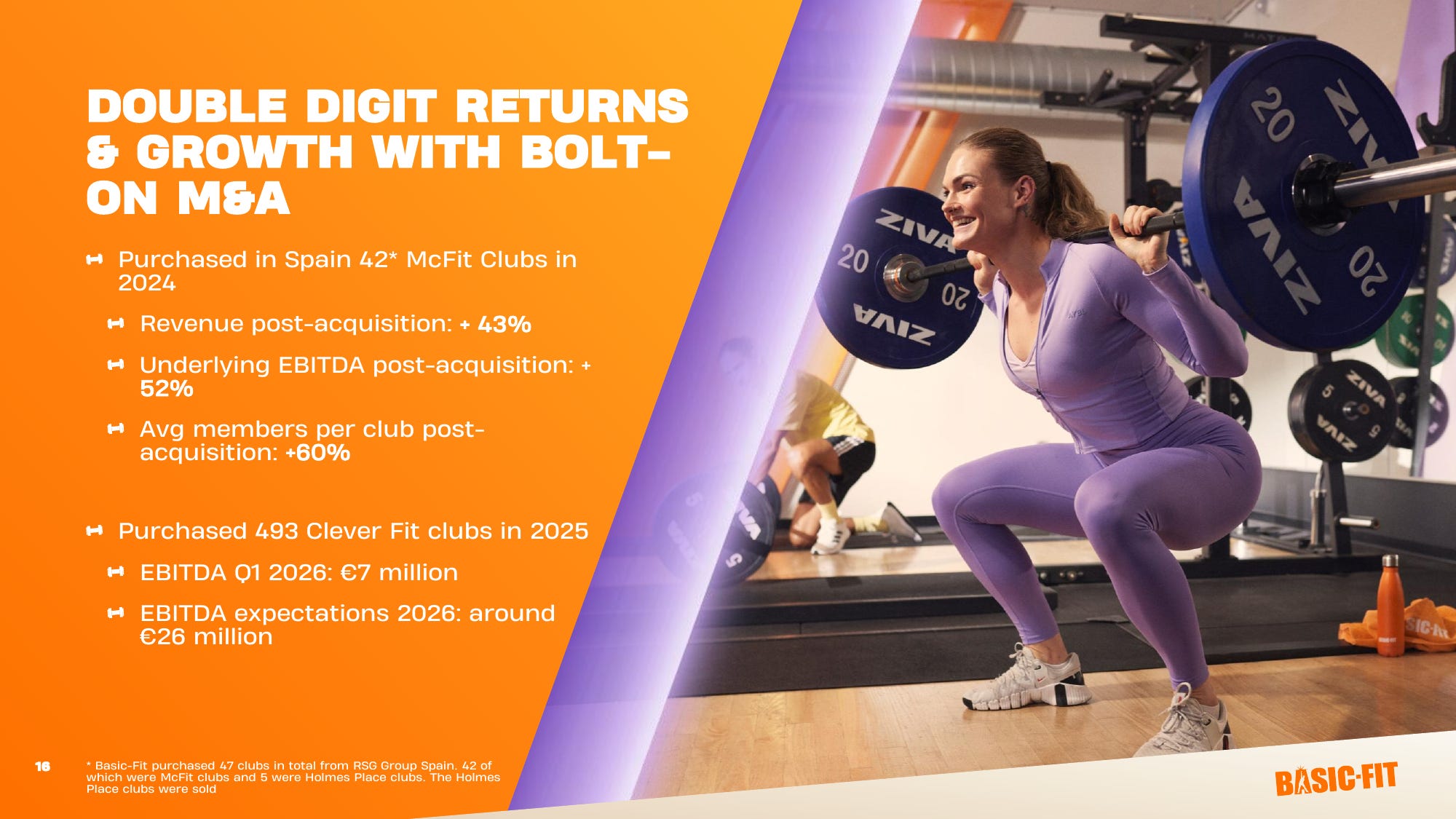
Acquisitions are where most of my disagreement with management sits. When Basic-Fit bought 47 clubs from RSG Group in Spain in 2024, 42 of them McFits, management said the total cost per club, including rebranding, would be “not much more than the normal new rollout.” It also targeted a return on invested capital of at least 30% by 2026. At the Capital Markets Day it reported revenue up 43%, underlying EBITDA up 52% and average members per club up 60%.
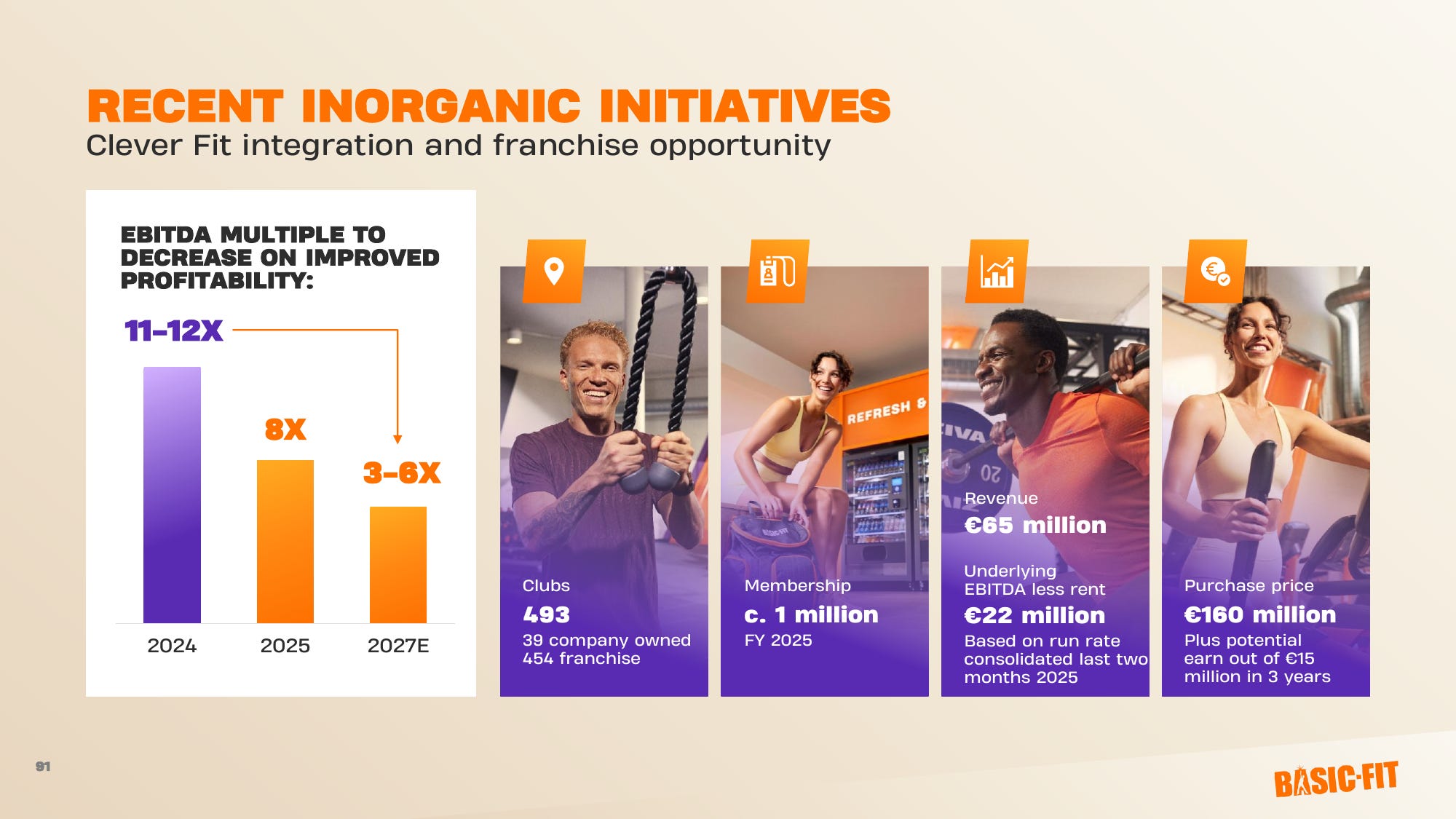
Management clearly expects to do it again. For Clever Fit, bought for €160 million plus up to €15 million of earn-out, its presentation shows the EBITDA multiple falling from 11-12x on 2024 earnings to an expected 3-6x by 2027. Much of that price, in other words, rests on profits that hadn’t been earned yet when the deal was signed.
On wellyou, bought at 5.3x 2025 club EBITDA, Moos told analysts in July that “their average ARPU is much lower than ours,” and put the cost of rebranding at about €250,000 a club. For Speedfit and Kraftwerk, the company “expects their profitability to converge with the Group’s average.” I wanted to turn that word, convergence, into a return.
The 67 clubs agreed this year cost about €1.41 million each once rebranding is added to the €1.16 million purchase price. That is a little less than a new club, and they come with members already signed up, but they do not come with Basic-Fit’s earnings. What they earned before the deals hasn’t been published, so I’ve had to estimate it: about €95,000 a year after rent, taking wellyou’s €239,000 of club EBITDA and deducting a rent I put at around €145,000. It’s the number I’m least comfortable with in this piece, and exactly the kind of figure I have asked Basic-Fit to publish.
From that starting point I model three outcomes. If the clubs fully converge, they end up earning what an average mature Basic-Fit club earns at club level, about €350,000 a year after rent, and the acquisition returns roughly 13%. (New clubs are bigger and cost more, so I model them at about €410,000 at maturity.) If only half the gap closes, earnings reach about €225,000 and the return drops to about 8%. If nothing improves, the club stays at about €95,000 and the return is -3.7%.
Full convergence beats the 12% buyback hurdle, then, but only by about a point, while half convergence falls four points short. At €28.48 a share, an acquired club needs to reach roughly €325,000 of EBITDA less rent in my model just to match buying more of the existing estate. That bar moves with the share price. At around €55, a deal that only half converges would earn the same as a buyback, so my preference for buybacks is a view about today’s price, and I would change it if the price changed enough.
McFit is harder to place on that scale than it looks. Management’s 30% target for the Spanish deal implies at least full convergence. The reported 52%, however, is an increase in EBITDA before rent. Apply it to a wellyou club, with €239,000 of EBITDA and about €145,000 of rent, and you get roughly €220,000 after rent, which is half convergence. I don’t take that to mean McFit disappointed. Its clubs started from a different base than wellyou’s, and the figures were published about two years after the deal, so this is an illustration and not an estimate of what McFit actually earns. So which is McFit closer to, full or half? The evidence published so far can’t tell, and that’s the gap the scorecard I’ve asked for would close.
Debt and buybacks
Net debt excluding leases was €1.06 billion at the end of June. If Basic-Fit chose to repay some of it, I would expect the money to go first against its floating-rate bank debt, €795 million of loans and revolving credit, which I estimate costs around 5% a year before tax, or about 3.7% after. That is the return on repaying it: certain, which is worth something, but low enough that the shares would have to trade at about four times today’s price before repaying debt beat buying them back.
Some debt reduction still makes sense to me. Both of the paths modelled below bring net debt down to 2.0x EBITDA less rent in 2027, which seems a reasonable amount of caution. Beyond that, I find it hard to argue for repaying more debt at under 4% when the existing estate offers about three times as much.
At today’s price a buyback sits about three points below a new club and about four above an acquisition that only half converges. I’m not arguing for buybacks instead of growth. My point is narrower: cash that can’t go into new clubs, or into deals that clear the 12% hurdle, should go back to shareholders instead of sitting on the balance sheet or being spent on a token programme. And given how uncertain the acquisition numbers are, I would want a deal to beat the hurdle by a clear margin before preferring it.
There are two caveats. The case for buybacks weakens as the share price rises, so it partly undoes itself if it works. And the 12% assumes debt stays roughly in line with earnings, so it is not the return you would get from borrowing more to buy back shares.
How many deals Basic-Fit can do
Even with good deals on offer, there’s a practical limit on how many clubs Basic-Fit can find, buy and convert, while the cash it has to put to work keeps growing. Management hasn’t given an allocation budget, so I’ve built two scenarios of my own. In both, net debt is reduced to 2.0x EBITDA less rent in 2027 and then held flat in euros, and from 2027 Basic-Fit opens 60 clubs a year, the middle of its guidance. Under Path A, management pushes hard on deals: 20% of free cash flow goes to buybacks, and whatever is left after the new clubs goes into acquisitions. In Path B, acquisitions are capped at 70 clubs a year, roughly this year’s pace, and the rest of the cash goes into buybacks.
Path A runs into trouble before returns even come into it. To spend its cash, it needs about 130 acquired clubs a year, more than 1,100 over the decade. Basic-Fit bought 47 owned clubs in 2024 (RSG Spain), took on 23 owned clubs with Clever Fit in 2025, and has agreed 67 this year, plus 16 bought from a Clever Fit franchisee. Path A would need more than one and a half times this year’s pace, year after year.
The targets exist: only 16% of German clubs belong to a major chain, and management talks about “multiple acquisition options.” But it’s looking for small and medium-sized chains with similar clubs and room to improve EBITDA, which means deals of 20 to 50 clubs, so Path A would need three or four wellyous every year. Conversions take time as well. Moos said in July that Basic-Fit doesn’t change signs during the September-October and January-February sales periods, and that in Austria it has to wait for local permits: “it’s not in our hands.” Of the Clever Fit clubs bought in November 2025, the first two in Germany had been converted by July. Price is another worry, because Basic-Fit isn’t the only consolidator (VivaGym and AltaFit have merged in Spain), and a buyer that has cash to deploy tends to pay more. I would also expect the quality of targets to slip as the easiest ones get bought, although I can’t put a number on that.
That’s why Path B caps acquisitions at 70 a year, and why it’s worth looking at what happens to the cash that can’t find a deal. Left on the balance sheet, it costs shareholders about two points of annual return. Put into buybacks, it does no worse than Path A in any of my cases: the two paths come out level when acquisitions fully converge, and Path B does better when they don’t. Part of the reason is the small gap between a fully converging deal and the buyback hurdle. The other part is timing, because an acquired club takes three to four years to reach its target while a buyback cuts the share count straight away. Valued on actual 2035 cash flow, Path B even comes out ahead with full convergence; giving every club credit for its mature earnings, including the ones bought late in the decade, brings the two level, and that’s the basis I use in the table. So the limit on deal flow doesn’t worry me much in itself. If you own the stock, the thing to watch is surplus cash piling up, or management stretching for weaker deals to use it.
The ten-year model
I ran both paths to 2035 under the three convergence cases. At the end, the business is valued at today’s free cash flow yield of about 10%, with clubs that are still ramping up credited at their mature earnings, and buybacks along the way happen at that same yield. There’s no re-rating in these numbers.
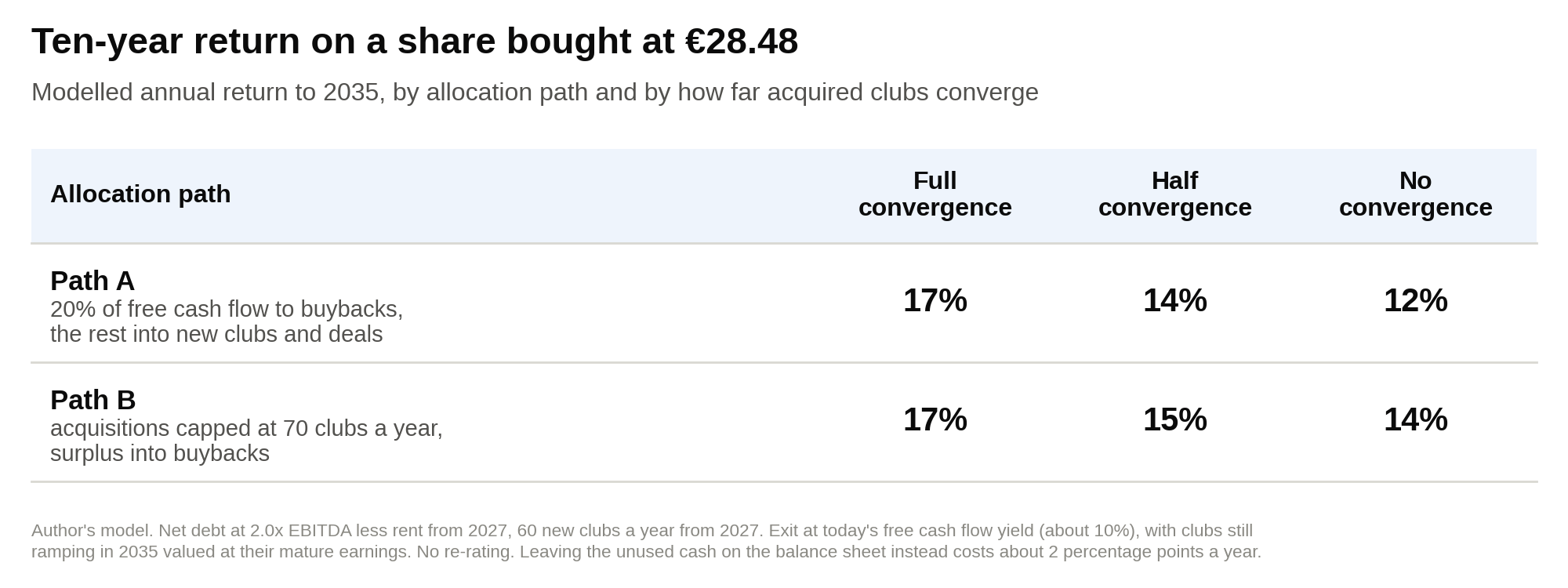
Path B ends the decade with about 2,800 owned clubs against 3,200 to 3,400 in Path A, and with roughly 50 million shares instead of 61 million. Its free cash flow per share grows at about 13% to 16% a year. If the market paid 12.5x free cash flow at the end instead of 10x, you could add about three points to every figure. Without that, returns from €28.48 come out at roughly 12% to 17% a year. How well the acquisitions converge explains most of the spread, and the allocation path mainly decides how much a disappointment costs. The range is best used to compare the two paths; I wouldn’t lean on any single number ten years out.
My letter to the board
On 30 September I sent a one-page letter to Jan van Nieuwenhuizen, who chairs Basic-Fit’s Supervisory Board, through the company’s investor relations team. I haven’t heard back yet. When I sent it, I told Investor Relations there was no rush ahead of the Q3 update, so I don’t read anything into the silence. The full text is at the end of this piece.
It asks for an annual acquisition scorecard in the Annual Report or the full-year presentation. For each group of owned clubs Basic-Fit buys (RSG Spain, wellyou, Speedfit, Kraftwerk and whatever comes next), I’d like to see what it paid including rebranding, and members, revenue and EBITDA less rent per club before the deal and one and two years after rebranding. Clever Fit needs different treatment, because 454 of its 493 clubs at the Capital Markets Day were franchised; comparing its EBITDA with the expectation management gave in April would do the same job. The letter also asks for each group to be compared, after one and two years, with what Basic-Fit said when it announced the deal and with the return criteria the Board applies to acquisitions.
It makes no request for buybacks. That’s my own view at this price, and management (or you) can reasonably disagree with my assumptions. Published results would give both sides firmer ground: if the McFit approach works at scale, the scorecard will show it, and if some deals fall short, shareholders will know early. Whatever the reply, what Basic-Fit chooses to disclose about its acquired clubs over the next few reporting cycles will say more.
What would change my mind
Over the next few results, I’ll be watching whether wellyou, Speedfit, Kraftwerk and Clever Fit move toward Basic-Fit’s economics after rebranding. If they stay well short, the case for sending more cash to buybacks gets stronger. Purchase prices matter too, since higher multiples can absorb the gains from good integration, so I’ll compare each new deal with the buyback hurdle at the share price of the day. New clubs have to keep earning their place at the top of the list; if mature clubs stop reaching something close to a 30% club return, every comparison in this piece shifts. I’ll also be watching what happens to cash that can’t find a deal. A growing pile on the balance sheet, or deals that keep coming in below the buyback hurdle, would make me less confident in how Basic-Fit allocates its cash.
Where that leaves me
Basic-Fit doesn’t need acquisitions for the investment case to work. The existing clubs already generate the cash, and new clubs earn more than anything else on the list, which is why I’d set a high bar for buying other people’s clubs. Management doesn’t have to make every acquisition beat every alternative in every year. But if acquisitions are going to stay second in line for Basic-Fit’s cash, shareholders should be able to see what they earn, and that’s what the scorecard is for. For now, my position stays small.
À bientôt,
Guillaume
Disclosure: I own BFIT shares (small position). Figures and prices are as of 2 October 2026. This is not investment advice.
Appendix: the letter I sent on 30 September
To: Mr Jan van Nieuwenhuizen, Chair of the Supervisory Board, Basic-Fit N.V.
Subject: Proposal for an acquisition performance scorecard
Dear Mr van Nieuwenhuizen, dear members of the Supervisory Board,
I am a Basic-Fit shareholder and write The French Prophet, an independent investment newsletter. In preparing recent research, I have been in touch with Basic-Fit’s Investor Relations team, whose answers helped refine my analysis. I support the consolidation strategy presented at the April Capital Markets Day.
The case for the strategy is strong. After Basic-Fit acquired 42 McFit clubs in Spain, revenue rose 43%, underlying EBITDA 52% and average members per club 60%. The Capital Markets Day also showed the Clever Fit EBITDA multiple expected to fall from 11-12x on 2024 earnings to 3-6x by 2027. If that playbook is repeatable, bolt-on acquisitions can create substantial value.
My concern is that shareholders currently have little ability to test whether it is repeating. At announcement, we learn the purchase price, club and member counts, and sometimes an EBITDA multiple. After closing, the acquired clubs are absorbed into Group figures. The clearest disclosure of the McFit outcome came at the Capital Markets Day, two years after the transaction.
If the McFit playbook is repeatable, more systematic disclosure should strengthen management’s case for consolidation rather than constrain it.
I would therefore ask the Board to consider a simple annual acquisition performance scorecard, published in the Annual Report or full-year presentation, with two elements:
1. Cohort operating outcomes. For each group of owned clubs acquired (RSG Spain, wellyou, Speedfit, Kraftwerk and future deals), disclose the total consideration and rebranding capex, and members, revenue and EBITDA less rent per club for the twelve months before acquisition and at twelve and twenty-four months after rebranding. For Clever Fit, which is mostly franchised, its EBITDA against the Capital Markets Day expectation would do the same.
2. Performance against the original investment case. After one and two years, compare each cohort with what Basic-Fit said at announcement (purchase multiple, expected EBITDA or convergence with Group averages) and with the Board’s return criteria.
I appreciate that some figures may need to be aggregated where commercially sensitive. The objective is not to prescribe a particular acquisition strategy, but to make the outcomes measurable against Basic-Fit’s own return criteria.
Most of this information should already exist internally: management was able to present the McFit figures at the Capital Markets Day. If the playbook works at scale, the scorecard would demonstrate it and allow investors to assess the value created by the consolidation strategy. If some deals fall short, shareholders would see it early, together with how management is responding.
Would the Board consider such a scorecard for the 2026 Annual Report or full-year presentation?
For transparency, I write publicly about Basic-Fit and intend to publish this letter. I would not quote any reply without your agreement. I would be grateful if you could confirm that the letter has reached the Supervisory Board.
Yours sincerely,
Guillaume Kaminer
Sources
Basic-Fit: Half-Year Report 2026 (including note 18, Borrowings); Capital Markets Day presentation (21 April 2026); press releases of 21 December 2023 (RSG Spain), 13 May 2025 (buyback), 1 July, 12 August and 10 September 2026; results calls of March 2024 and 28 July 2026.
Impactive Capital, letter to Basic-Fit’s CEO and Supervisory Board, 19 December 2024.
Market data as of 2 October 2026. Model: author’s.